A Prie Dieu is a small individual praying desk. It is characterized by a padded knee bench and a top vertical panel to hold a book, or as an arm support during prayer. On November 26, 2000, this teak Prie Dieu was dedicated to the memory of Sidney Thwing, a long time member of St. Mary’s, for use in the Chapel. The Prie Dieu was made by Michael Power, the brother of Sidney’s daughter-in-law, Liz Thwing.
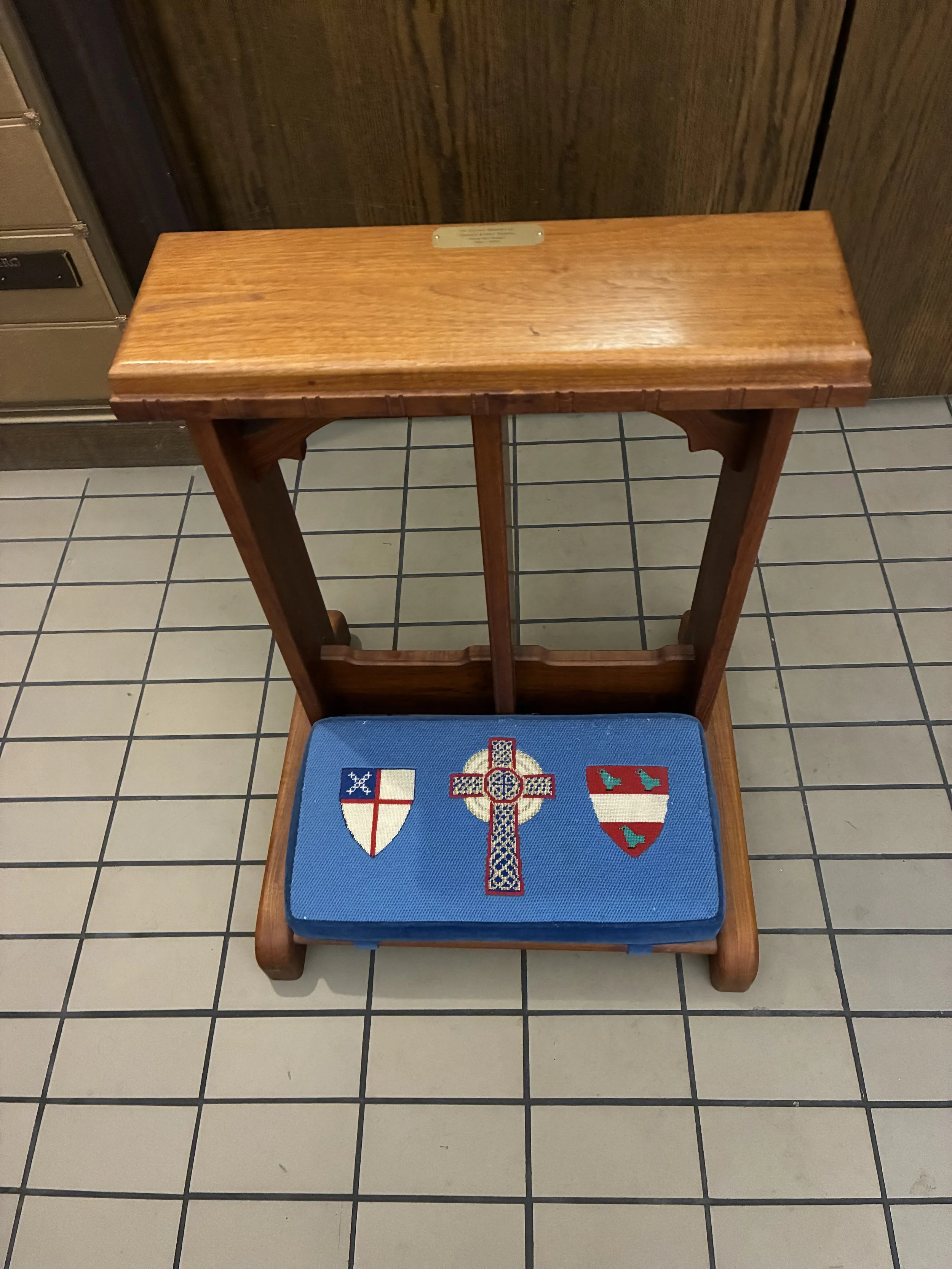
The needlework pad is a gift from the Parish of St. Edburgha of Yardley-Birmingham. The earliest documented date of St. Edburgha Yardley is 1187, but it could be as early as 1165. St. Edburgha’s was the home parish of Deacon Penny Berktold, wife of Fr. Ted Berktold. Penny attended this church as an infant until she was nineteen years old.
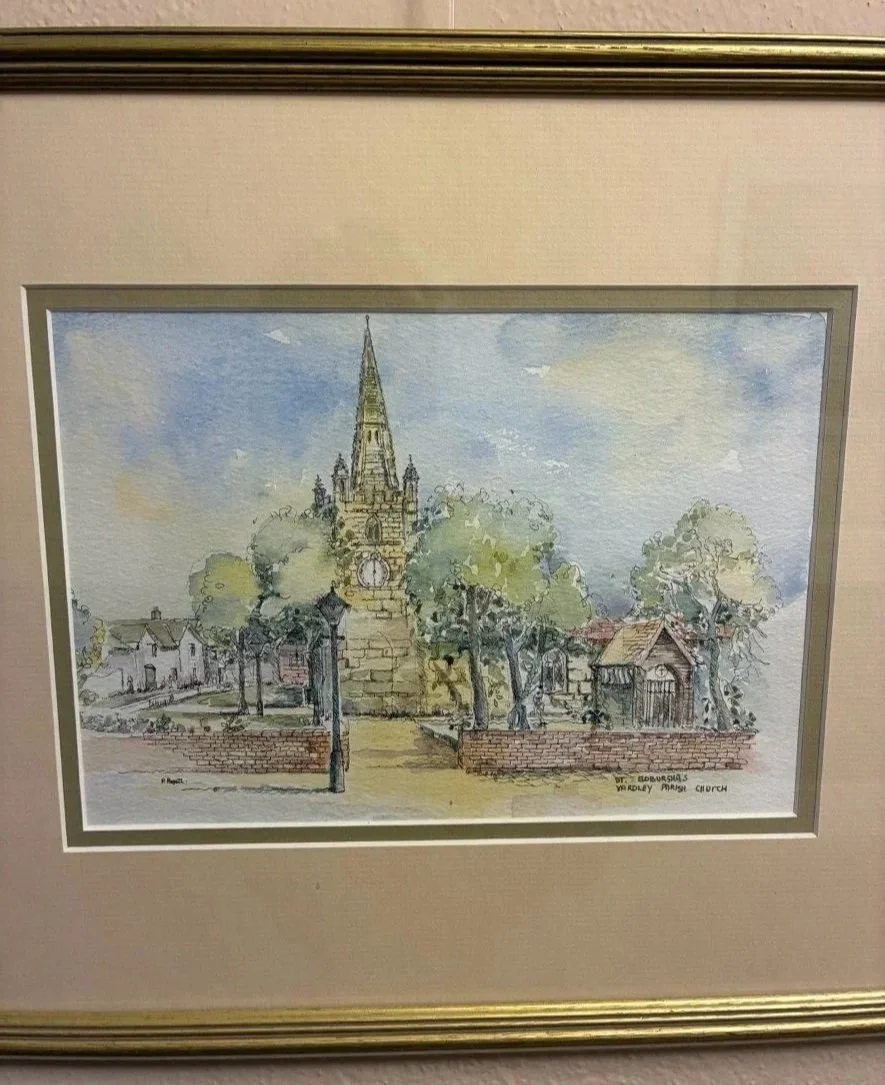
Painting of St. Edburgha’s Yardley-Birmingham
From 2002-2005, Fr. Nick Parker served as St. Mary’s assistant priest. He, like Penny, was from England, and in 2004 St. Mary’s hosted a Youth Group from Yardley-Birmingham to visit St. Mary’s. The mother of one of the youth attending made the needlepoint kneeler as a gift to the parish.
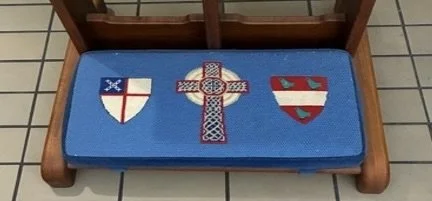
The needlepoint kneeler contains three Christian symbols. The one on the left is the shield of the Episcopal Church, the official “logo” of The Episcopal Church. It shows a red Cross of St. George on a white field, a symbol of the Church of England from which the Episcopal Church was formed. The blue field in the upper left features a Cross of St. Andrew, in recognition of the fact that the first American bishop was consecrated in Scotland. This cross is made up of nine crosslets or mini crosses, which represent the nine dioceses that met in Philadelphia in 1789 to form the Protestant Episcopal Church of the U.S.A.
The second symbol on the kneeler is the Celtic cross. The Celtic cross features a ring or nimbus that encircles the arms of the cross. It symbolizes God’s eternal love and the unbreakable bond between heaven and earth. The Celtic Cross emerged during the Early Middle Ages, between the 5th and 8th centuries, in Ireland and surrounding regions.
The third symbol of three blue birds in a triangular formation symbolizes the Holy Trinity—Father, Son, and Holy Spirit. Although the Bible does not specifically mention bluebirds, their traits align closely with biblical themes. In Matthew 6:26, Jesus says that God provides for the birds of the air, signifying His care for all creation. The Holy Spirit is depicted as a dove in Matthew 3:16. These representations underscore the use of birds in understanding God’s presence and intention.
The color blue often denotes heaven and divine revelation. In Exodus, a blue sapphire stone signifies God’s glory. The blue thread used in the garments of the priests symbolizes their role in mediating between God and the people. The tabernacle’s curtains contained the color blue, reminding the faithful of the divine nature of God’s dwelling. In Numbers, God instructs the Israelites to make tassels on their garments with a blue cord as a visual reminder to follow God’s commands and to live righteously. Blue is the liturgical color for St. Mary, the Mother of God and our Patron Saint. Each of these examples illustrates blue as more than a color; it’s a constant reminder of God’s presence and the covenant between Him and His people.