Please see this article about Paul and about the history of the Stations of the Cross.
Transcript of a presentation by Paul Buckner to the parish of St. Mary’s on April 7, 1982.
All photos by Carl Davaz.
Station 1 Jesus is condemned to death
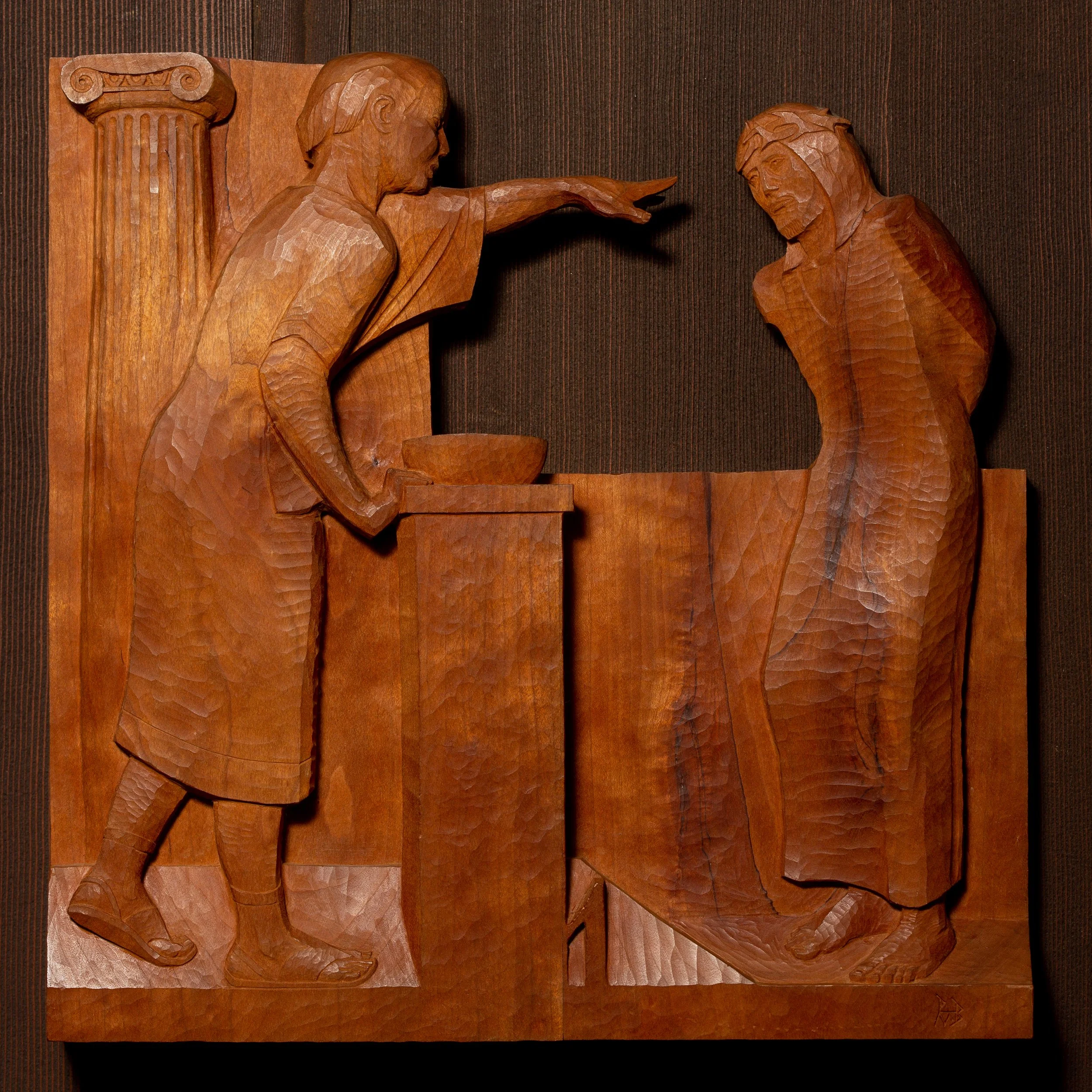
This is the station that I had imagined that we, we being my oldest son, Matthew, who is now 21 years old and I, would be able to carve each station in between four days and a week. After about three weeks of negotiating with each other and making drawings, including a full size model which Matthew made and I severely criticized, we went at it some more and finally arrived at this. This carving, working together and in spite of each other, took us about five weeks. This is when I realized that, like most students who envision carving a chest set, you carve a bishop and that is a lot of fun. Then you carve a knight, and that is also a lot of fun. Carving the king and queen is always a delight. The first pawn is easy. The second pawn isn’t so much fun, and by the time you have gone through a full chess set with all those little pawns. . . . Let’s just say I began to imagine that it might be Easter sometime in the 1990s before St. Mary’s would get their Stations of the Cross.
Matthew was responsible for the architecture in the background. He put in a column of Ionic Order which would be quite accurate to the time. By that I mean that the Ionic Order would have been around long enough that it would have been well established. The Pilate figure, with an outstretched arm, is the key to what I imagined for the other thirteen stations. That is, each station would have a particularly unusual element. In this rather high relief with the totally free standing arm, the grain is horizontal as opposed to the rest of the vertical grain. That was because touching of these carvings is invited, and I realized that if the arm was on the vertical grain the finger would not last long if someone touched it. But as it is, I think it will stand the snagging of a scarf or a glove without breaking it.
I saw Pilate as a bureaucrat, a person who was relatively innocent of what seemed to be going on, and that seems to be demonstrated historically. He was just a Roman stationed in this wild place. He was eager to get off the judgment seat, which had partly to do with his rather domineering wife who had had a dream about this event. I tried very hard to portray how it might have been at the final desperate moment when Pilate realized that events were beyond him, and that it would be easiest thing in the world now to say, so be it. You are condemned. He had tried to get the simplest confession, but it was not forthcoming. Jesus knew the events that had to happen to fulfill the prophecy.
Question from the audience: Is that the bowl that symbolizes Pilate's attempt to wash his hands of responsibility for Jesus' crucifixion?
Buckner response: That is the bowl. Matthew and I had quite the negotiation about how high the relief should be.
Station 2 Jesus takes up his cross
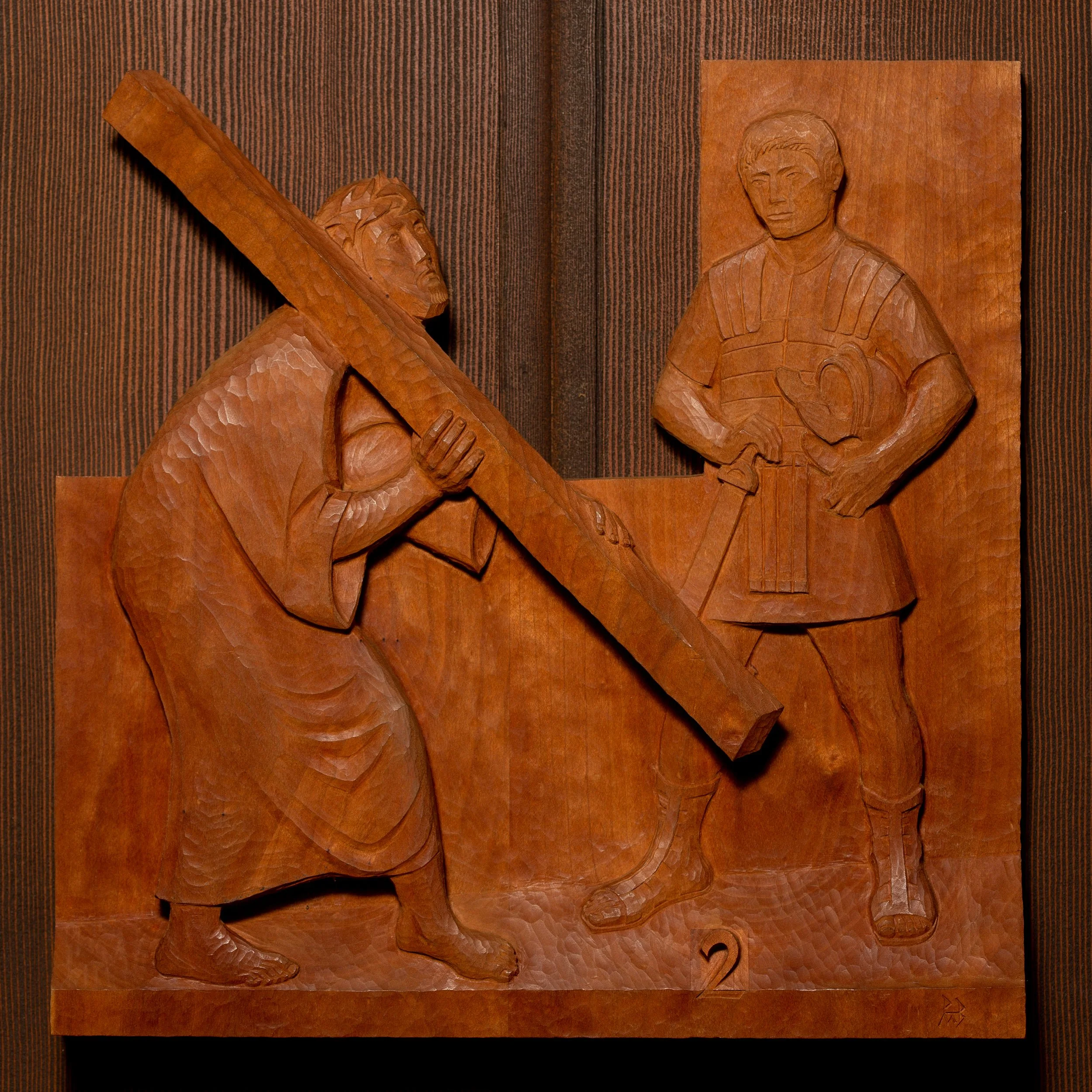
Here I realized that Matthew was more capable and much more willing than I to do the historical research, and I trusted him implicitly. The Roman uniform is apparently quite accurate. Matthew was always an enthusiastic child about armaments and history, and he saw to it that during our year in London during my first sabbatical from the University of Oregon, we spent hours and hours in the marvelous armament collection at the Victoria and Albert Museum. All of the highly ornamented armament became his domain. He was only too delighted to do them on the carvings, and I was only too delighted to allow him to do so. Probably 80% of the carving of the soldier’s uniform is Matthew’s work. He also helped me rough out all of the other figures in the other stations. We would have a little problem here and there, and we had some disagreements, but they became fewer and fewer as we went along. This is the first time I have said this, but I have the feeling that whatever kind of relationship that Matthew and I have, it has been immensely improved because of our work together on the carving of these stations of the cross. I realize that we had much disagreement in the first carvings, but as we went along he accommodated me, and I came to know his strengths and weaknesses. He grew considerably during this process, and that’s something that I have to remember to tell my wife. Matthew, by the way, is now studying at the Art Students League in New York and the National Academy of Design.
Technically, the relief on the stations are intended only to be seen from the front view. It is never intended to be seen on any kind of angle, but only the front view. It is, one hopes, the best of drawing and the best of sculpture, but neither one or the other entirely. If you get off to the side, you see surfaces which are not intended. But that always leaves the difficult proposition of changing the plane from the background, which is always simple, to the “ground” ground, which is not simple because it is no longer a flat surface and cannot be. This is an historic problem. It happens from the earliest Egyptian relief carvings to the present day. How does one treat the floor or ground plane relative to the background plane because of the radical change that has to happen.
It was at this station number 2 that I decided that St. Mary’s would probably appreciate having the stations numbered. I had thought at one time that they would not be numbered, that the order would be automatically understood, but there is some historic rationale and reason that seems to make sense. The number 2 was installed later as a piece of inlay, which is a process I enjoy immensely. The slight change of color around the number is the result of the inlay.
Question from the audience: inaudible, but the question can be deduced by Mr. Buckner’s answer.
Buckner response: There is a lot of historical evidence that the patibulum, or crossbar, was all that was carried. The entire cross would be impossible to carry, if one thinks about it. The cross had to be sturdy, probably at least seven or eight feet in height, and likely four to eight inches thick. For a person in the beaten condition of Jesus, who had been flogged severely, it would have been physically impossible to carry. It is clear, based on the writings of Saint Ignatius of Antioch, that the vertical part of the cross was permanent. It had a tendon on top where the crossbar was affixed with mortise and tenon joints. Thank you for the question, because it is important to understand the historical information behind my decision of using only the patibulum.
Question from the audience: We are used to seeing other pictures of Jesus carrying the entire crucifix.
Buckner response: I realize that is the tradition, and while I did stick with the traditional number of fourteen stations, it is impossible to describe everything with historic accuracy. For example, there is still debate, even among physiologists, about where the nails had to go in Jesus’s arm. I will talk about that later.
Question from the audience: How did you solve the problem of making the floor look flat?
Buckner reply: You can see that on this one we gradually lowered the plane so it is not entirely flat, as opposed to number one which is flat. In number one I dropped it straight back. In number two we showed a bit of the lower plane which left me just enough room to carve the feet. This seemed to us a good solution to a difficult problem.
Question from the audience: Did you solve some of the technical problems with plane and depths of your carving by using a clay model?
Buckner response: Not after station three. By that time we realized that Matthew and I could speak each other’s language, so we did not need to sketch each of them in a complete three dimension. We did sketch certain parts as it became necessary. That has always been my approach when I reach a snag in a carving. I will stop and get out the plasticine and make a model of it. I found that rather freeing instead of restricting in solving a technical problem.
Station 3 Jesus falls the first time
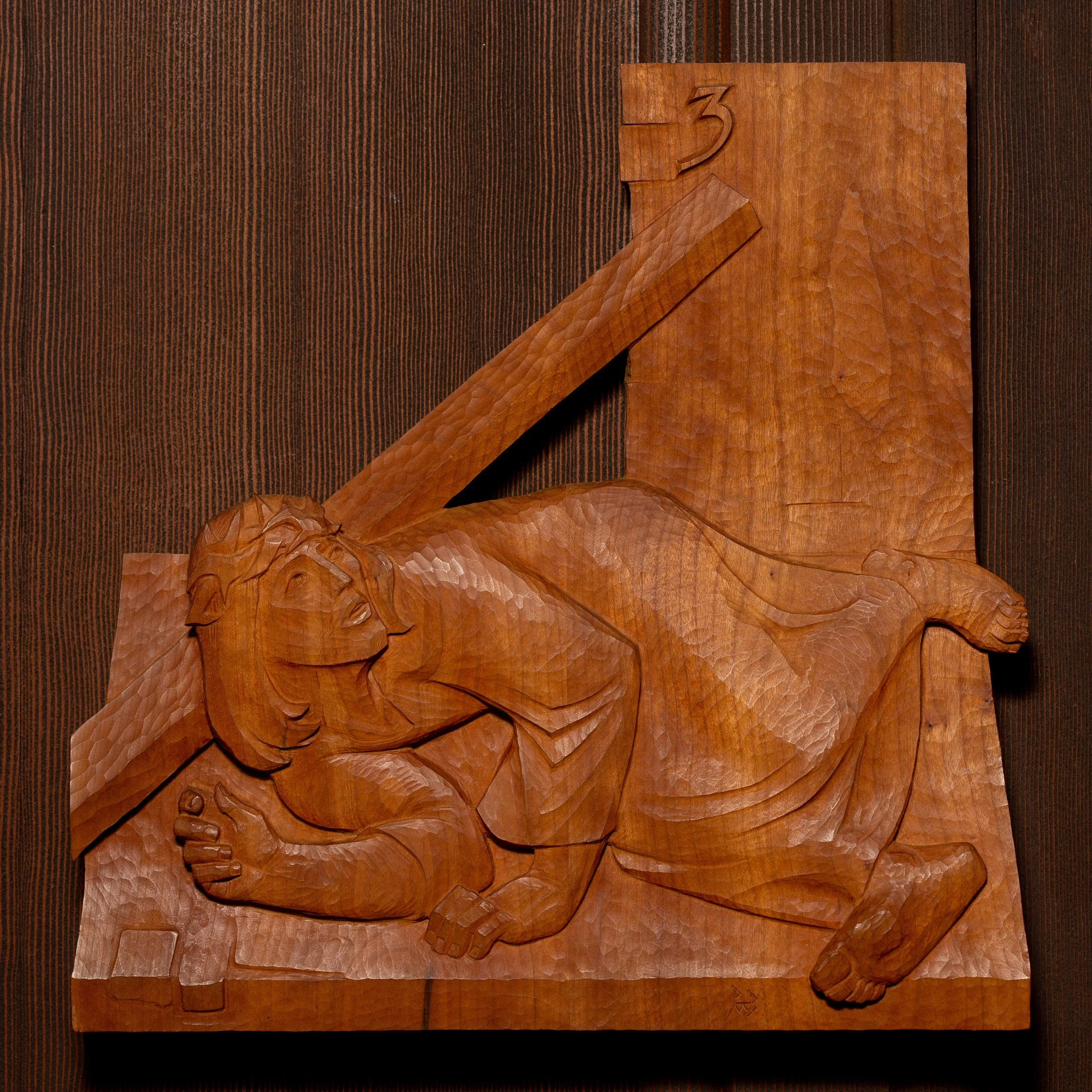
I enjoyed making this carving immensely. The hook in this one, the unusual event, is the foot on the right leg of Jesus that is coming closest to us. It is above the surface. I laminated an extra piece on top of the original surface of the carving so that it projects out. The toes of the left foot are carved with a gouge. The hands came out well, and any sculptor will tell you that those are the members that will really get you. There is a cartoon of a lovely Renaissance drawing with all the beautiful cross-hatching, and the hands are erased and scrubbed out. In their place are some Italian Renaissance words that are clearly not translatable. Matthew did most of the background in this one, and I took over and did the figure of Jesus’s first fall.
Station 4 Jesus meets his Blessed Mother
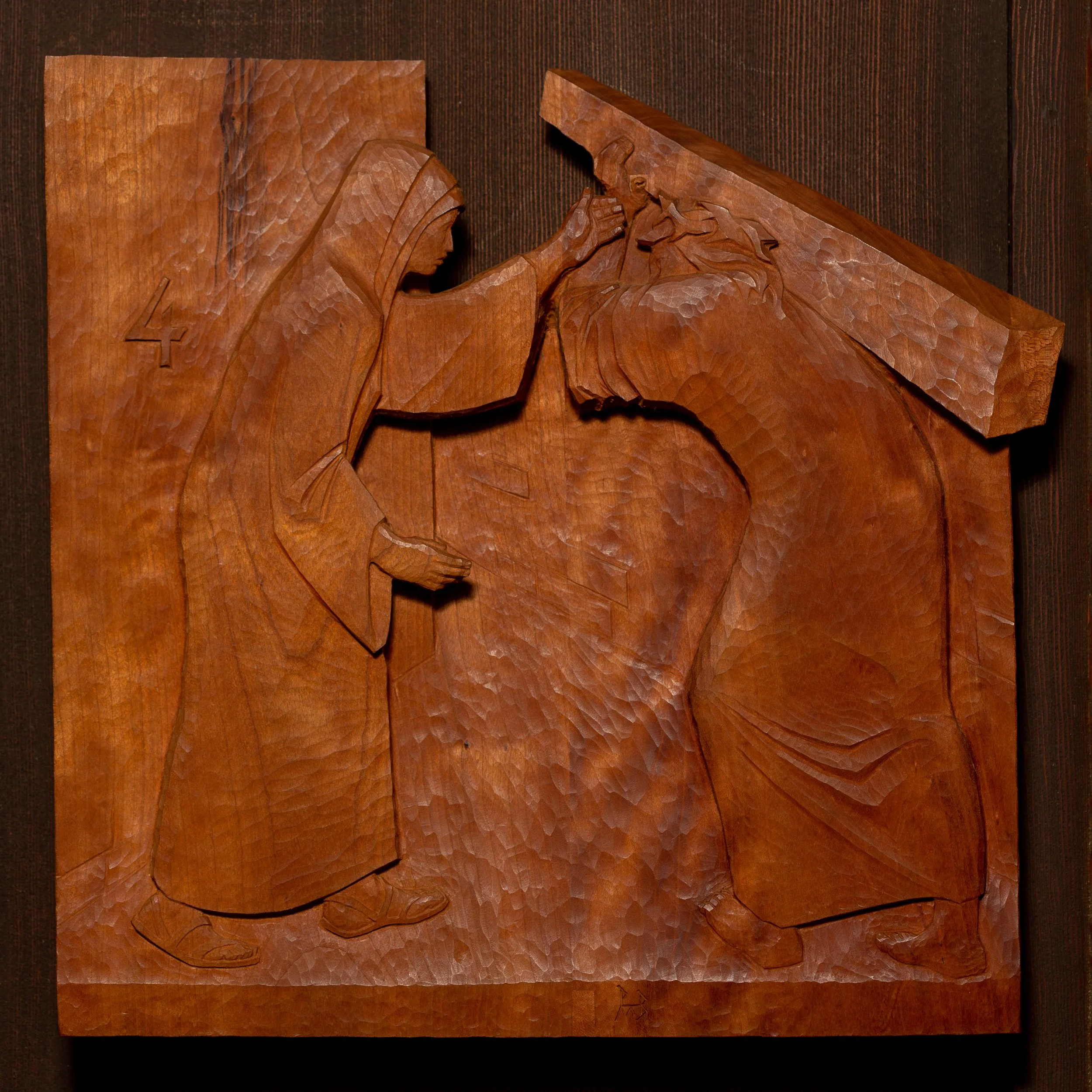
This one was a real problem for me in trying to imagine what the exchange between Jesus and Mary must have been. The mother knowing, and her son knowing that it would be his last communication with this strong, if not dominant, person in his life. There are really no words to describe what was going on between them, and I wanted this to come through in the carving. I had Mary not touch him. She is as helpless as he is. The events have gone too far. They both know what has to be. The strong diagonal and the deep perspective of the patibulum drive the whole thing back into an unknown space. The ground level on this one is simple and not deep in relief. My intention was to create a kind of almost ethereal shallowness to it.
Station 5 Simon of Cyrene helps Jesus carry the cross
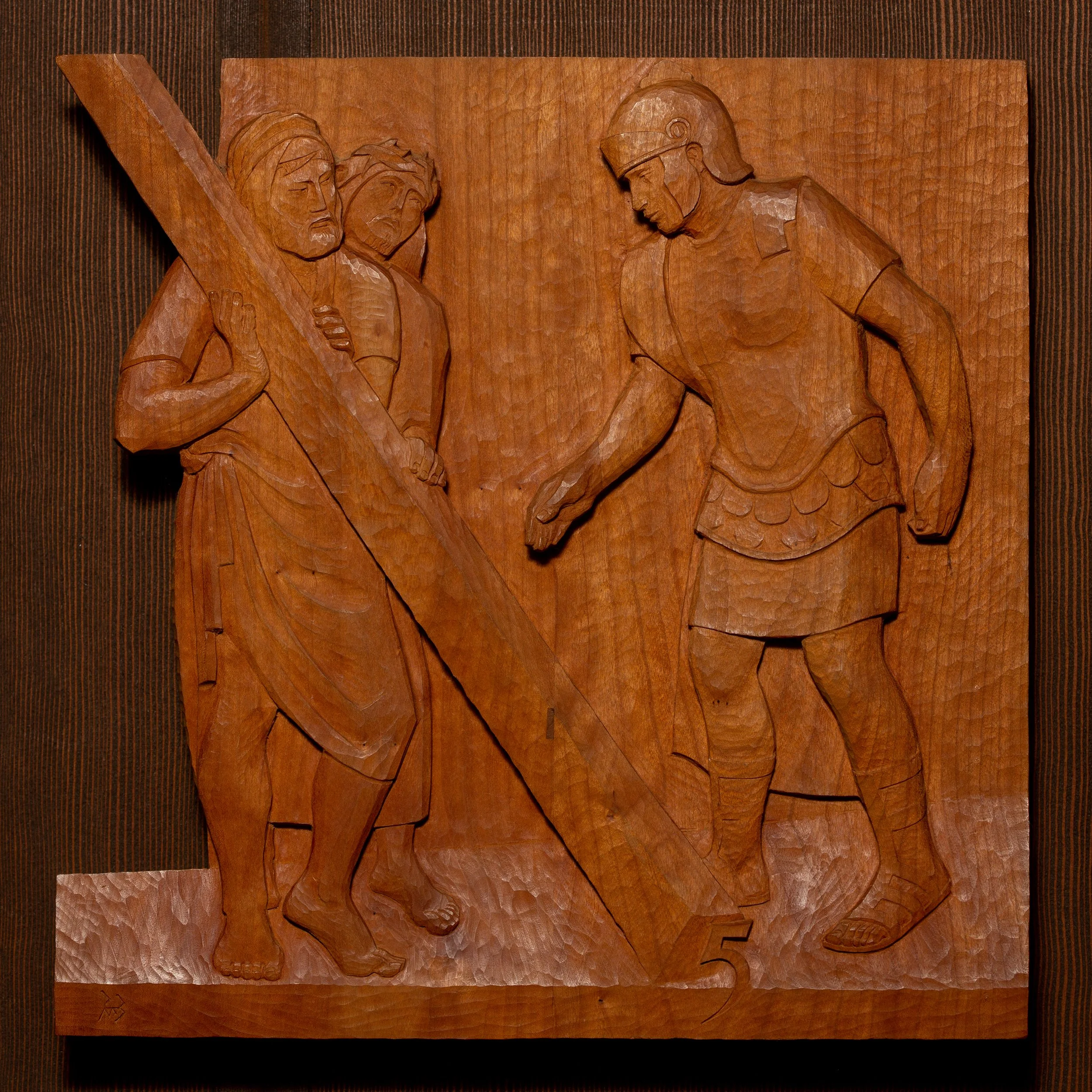
In other images of this story, the soldiers have been frequently shown as vicious monsters, but I chose to show these soldiers, as all soldiers stationed abroad always are, as lonely, thinking of home. They are just serving, putting in their time, as some of us have done. They are doing their duties. It was a common duty to oversee the criminals that were being sent to their just ends, so I chose not to brutalize the soldiers. The other character is Simon of Cyrene who was commanded to take over the burden of carrying the cross for Jesus. Jesus was clearly going to be unable to finish, and it was important the deed was taken care of before the Passover began. I placed Jesus behind Simon, reluctant to have the innocent fellow become part of this event.
Station 6 Veronica wipes Jesus' face
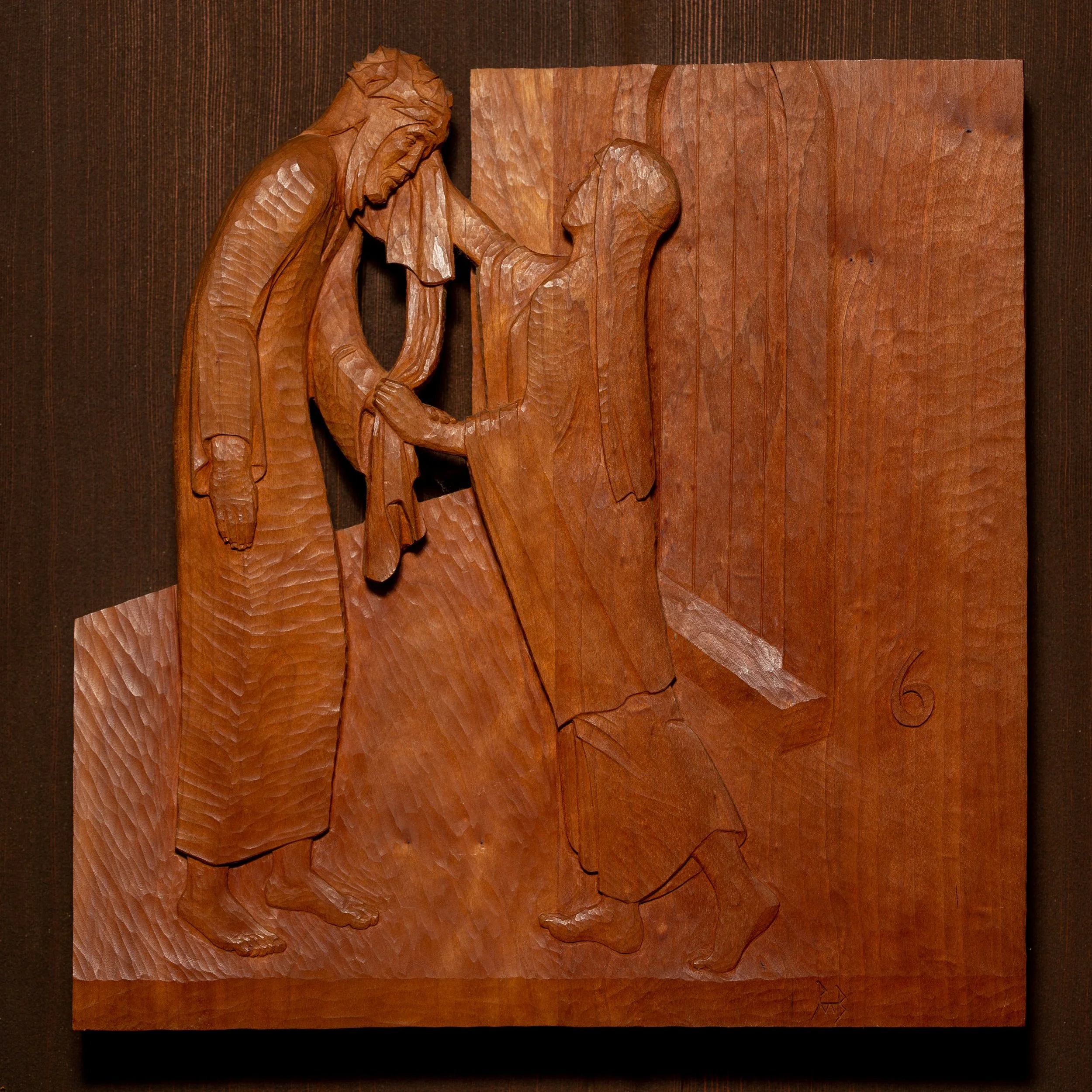
This carving is of Veronica wiping the face of Jesus. It does not read as heavily architectural as some of the other stations. I was interested in the technical aspect of the penetration, the excited negative spaces behind the towel and arms. The important thing was to show that this was the last time Jesus was touched with a loving gesture, the last loving earthly touch that he would receive. That idea meant a lot to me and was the key behind this particular station. Some of you may remember that my initial submission in the form of a pencil sketch was in the bulletin board downstairs for many months. That sketch was of what I had first imagined as Station 6, and it was quite a different composition than this one. But by the time I got to number 6, and by the way, we did carve these in order, my idea had changed. I had originally thought of this station as an exciting one with lots of dynamic action of the toweling of the face. But as it turns out, this is one of the more quiet compositions. It is a quieter, more humble and humane gesture than my original thought.
Station 7 Jesus falls the second time
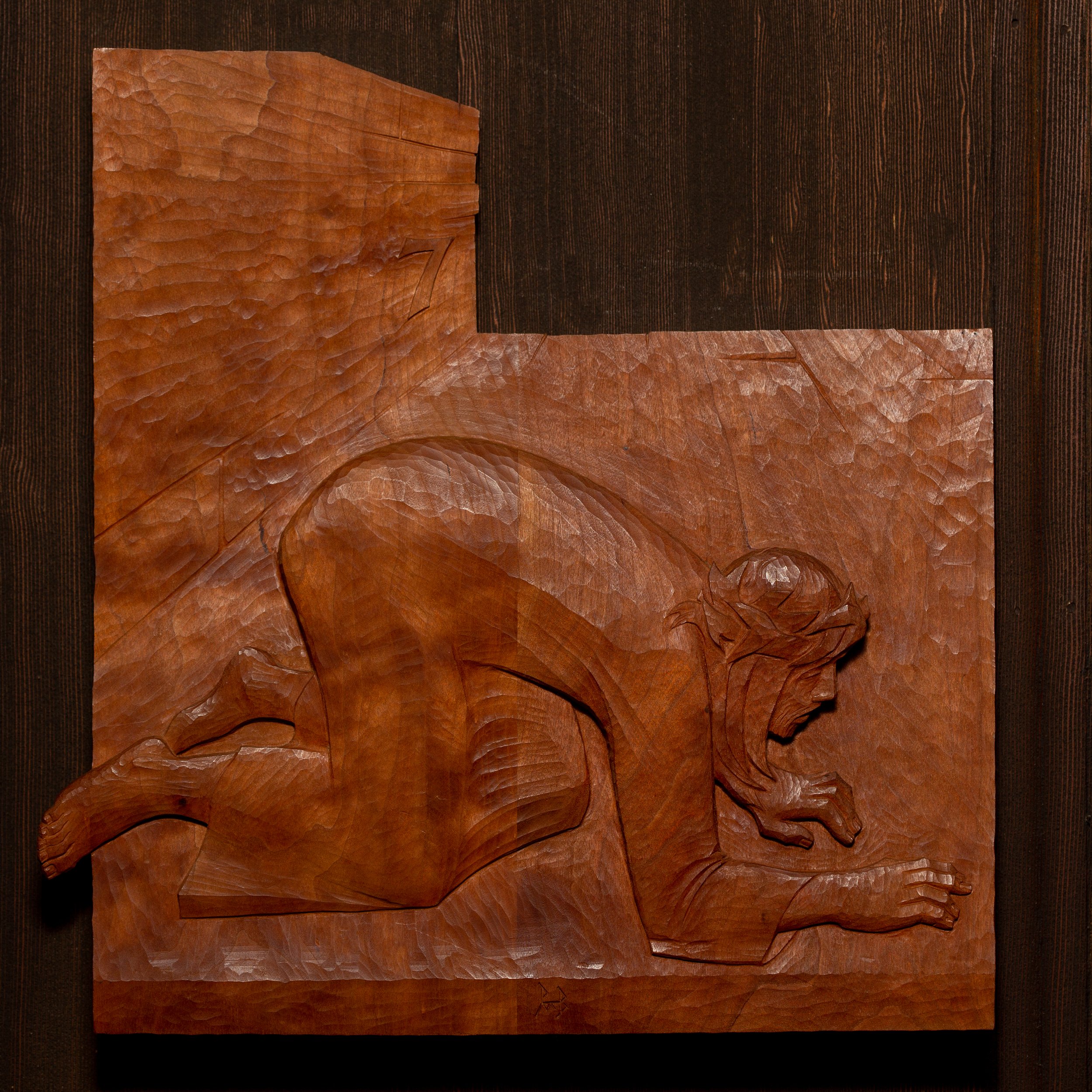
This is the 7th station, the second fall of Jesus. I am very pleased and proud of this carving, and part of it has to do with the scale of the piece. The first fall was of Jesus carrying the patibulum. This fall is a more crushing one. I had him fall face forward, catching himself with his elbows and knees. At this point in Jesus’s journey, his body was fatigued and driven and beaten, so I think the natural gesture at this point would have been like this. I chose to extend the foot beyond the limits of the carving. In this case, far beyond. There is something about the human foot. There is a lot of helplessness about it.
Station 8 Jesus meets the women of Jerusalem
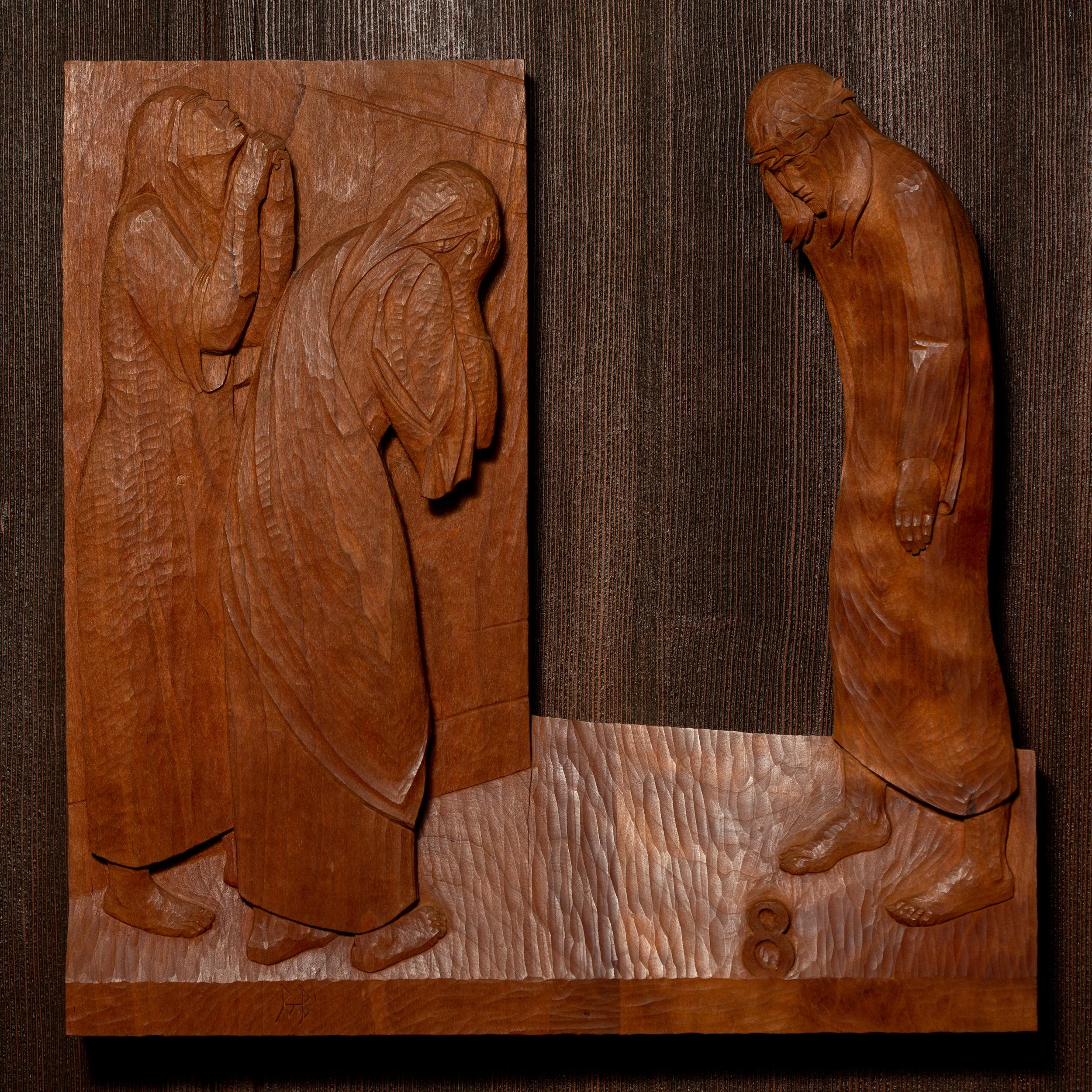
This is one of the few carvings that is laminated with more than two main pieces. The grain was so lovely in two of the blocks I had, but they weren’t quite wide enough, so I joined them with a centerpiece which shows up very clearly.
The weeping of women in the regions around the Mediterranean is a much more common thing. Even on the news today when we see evidence of a tragedy, there is a lot of wailing and crying. This is expected behavior. There seems to be some historical evidence that people were actually paid to do the mourning during these crucifixions. When I read that, I tried not to be cynical about it. I think Jesus would have had many, many followers familiar with him in Jerusalem, so there would have been plenty of people who were mourning this last journey of Jesus. I tried to make the gestures of these women appropriate, and I tried to make his responding gesture appropriate, also, as far as a person at this stage of fatigue could respond to the natural human condition of weeping.
Station 9 Jesus falls the third time
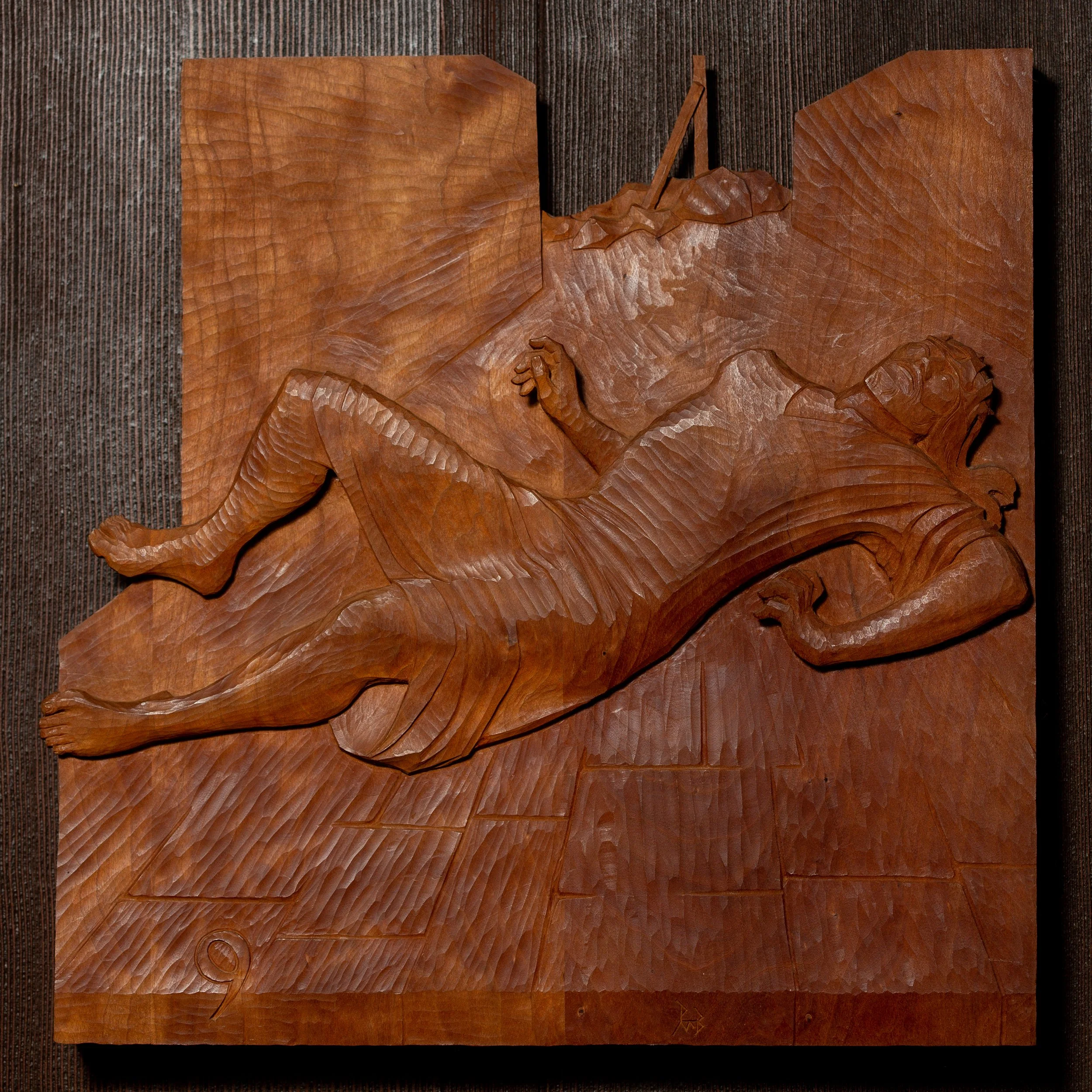
This is the last fall of Jesus, and this time it is a complete fall. He is on his back, totally fatigued, unable to control anything that could break his fall. The patibulum has been delivered and is leaning against the vertical part of the cross in the background. That is the key to this carving: the cross is ready for Jesus to be placed on it. The architectural pieces are there, waiting to be combined, after which it can only lead in one direction.
Question: Did you base your carvings on what was thought to be the actual weight and height of Jesus?
Buckner reply: I based my carvings on the evidence that he was somewhat taller than average, which was around 5’7”. If the Shroud of Turin is accurate, Jesus would have been 5’10”. He was probably very lean, although at this stage, knowing that he was fulfilling the prophecy and the agonies he had so far endured, even had he been a robust, physical type, he probably would have been weakened and emaciated by the time of this fall.
Question: I am curious about the horizontal lines at the bottom of the carvings.
Buckner response: The one main horizontal feature is a band that is ¾ of an inch high and appears at the bottom of the carvings. It is the one common design device that knit these particular fourteen pieces together . The directional features in this carving of Station 9 are diagonal, depicting paving stones that lead to the cross, which becomes the obvious single vanishing point in the sculpture.
Station 10 Jesus is stripped of His clothes
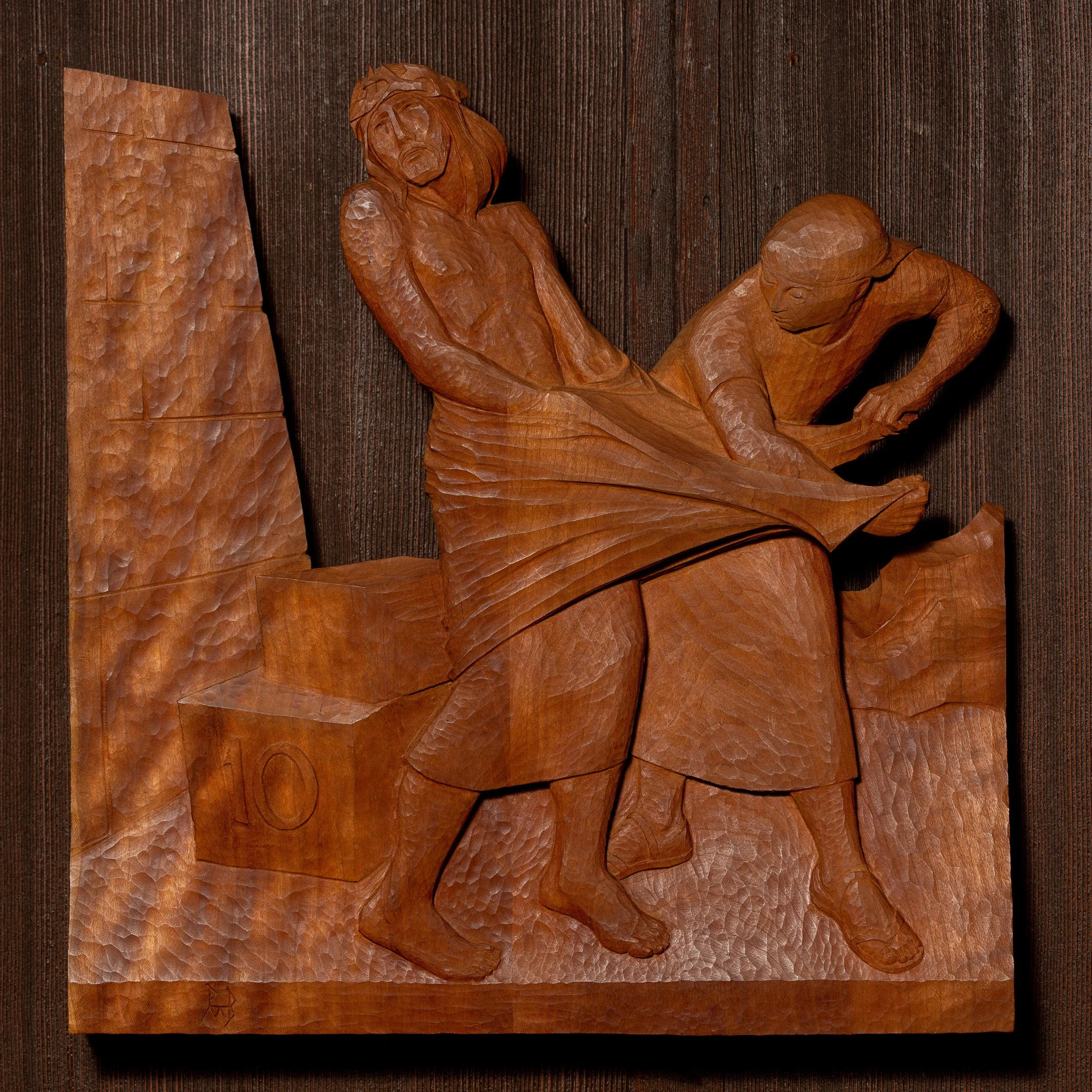
The stripping of the garments gave me an opportunity to carve some dynamic activity. This station and the next are the two most radically active dynamic carvings. They were easy to carve. Matthew was a great help. He did the carvings of the entire background on the left hand side, the numbers, and the blocks of architecture that I imagined would be lying outside the gates. The tiger bar grain of these particular pieces of cherry wood stands out very clearly. The grain is laid in a series of up and down marks, and when shaved across it takes on the same quality as the grain of velvet. When you see it in one light it goes one way and when you see it in another light it seems to go the other way.
Station 11 Jesus is nailed to the cross
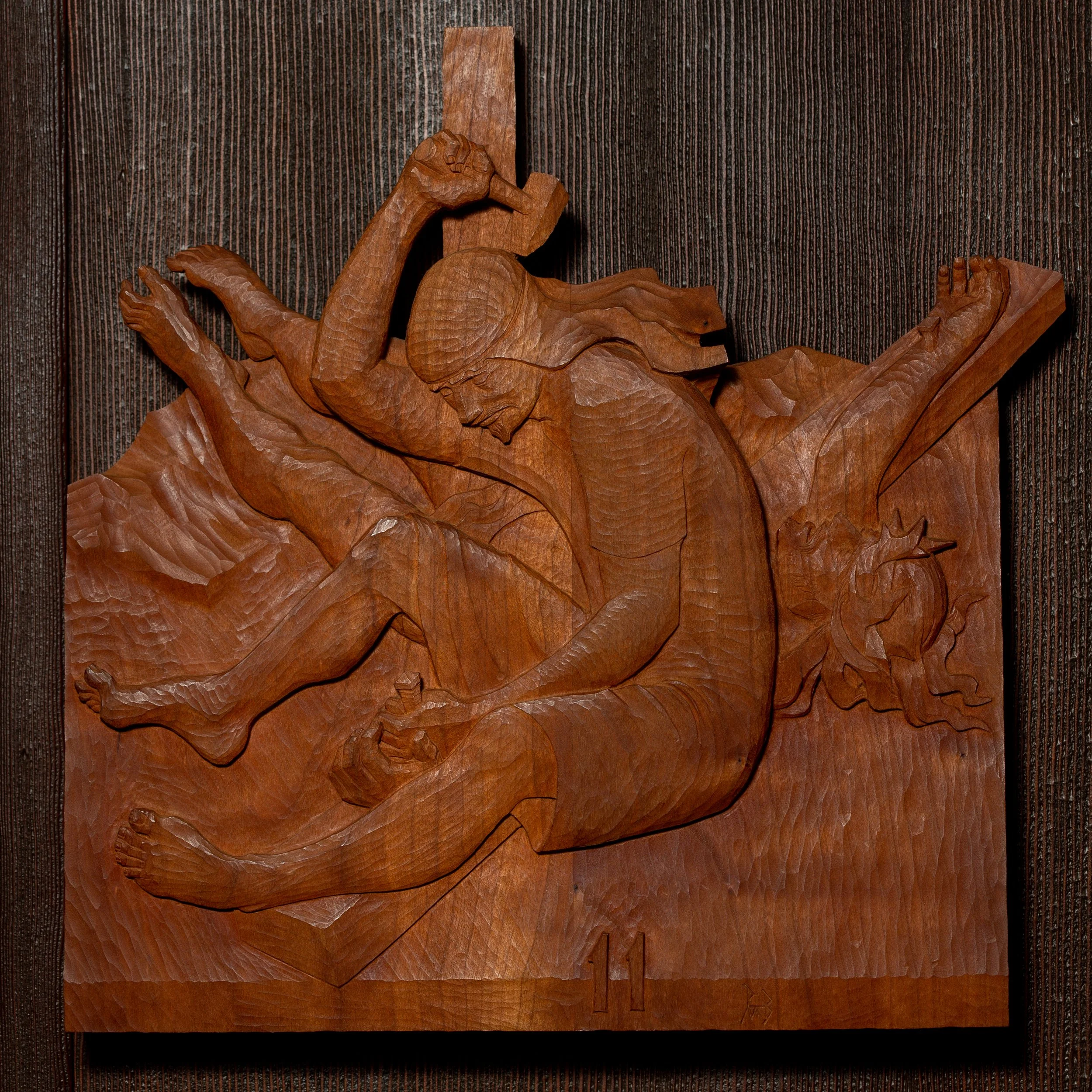
This is the nailing of Jesus onto the patibulum of the cross. I showed in absolute bold relief the hammer, and the human curling of the toes as a response to the severe, unimaginable pain of those large square metal nails being driven into his flesh. There is evidence that during this time when crucifixions were quite common, the nails were driven between the radius and ulna just above the wrist. That would be where the radius and ulna come together and articulate just about ¾ of an inch from the base of the thumb toward the elbow. The nail was not put in the center of the hand between the metacarpals, because the flesh would pull off almost instantly.
It is conceivable and possible the nail could have been driven through the center of the thumb through the carpals, but that meant there was a chance that severe and instant bleeding would have taken place. That was not their intention. The intention of crucifixion was to make it take as long as possible. They would not want their victims bleeding to death. They wanted it to be slow and painful.
Station 12 Jesus dies on the cross
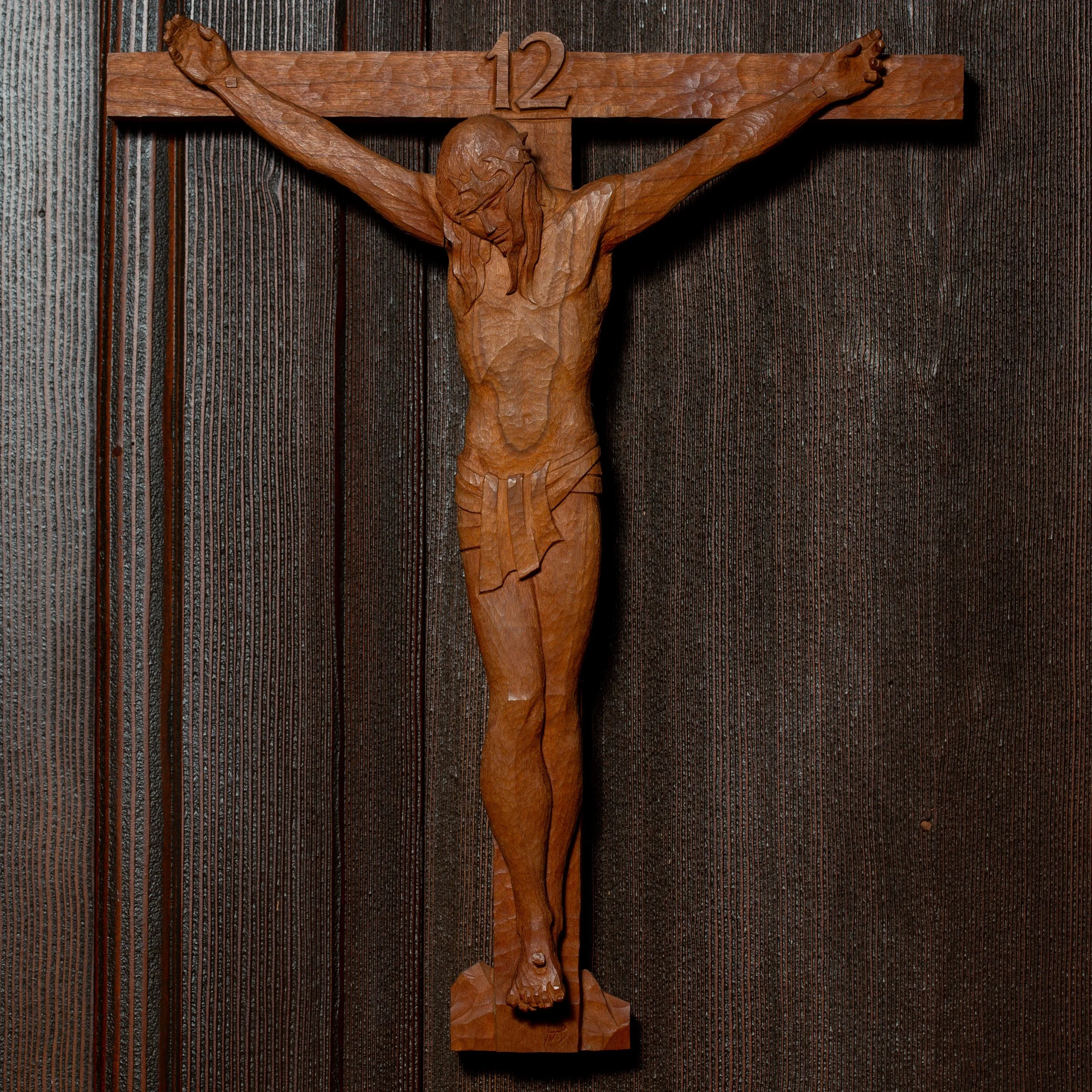
This is the first crucifixion I have ever carved. I have carved the risen Christ several times, carved Christ as an infant, as a child, as a teenager, and as an adult, but this is the first crucifixion I attempted. With this carving I was able to show my love for the body’s anatomy.
This is the one carving that I did out of sequence. This is the last station that I carved. I somehow didn’t feel that I wanted to carve this immediately after the previous one. I needed all the experience and all of the insights from the other thirteen. So I carved this one last.
What can one say about a crucifixion? The knees are slightly bent, the reason is that during a crucifixion the choking tendency and the radically impossible situation with the arms up creates a rapid death. The body quickly become unconscious if the pressure is allowed to remain unrelieved around the top of the thorax and the neck. If that can be relieved, then consciousness is regained quickly. The technique of crucifixion had been developed for a long time, so it was known that the instinctive response was to relieve the pressure on the neck by pushing down on the feet. This vicious and impossible-to-imagine situation was exactly what was intended. When the body has reached its limit, it will keep itself alive with an unconscious response of pushing the legs down, making the body erect and relieving the pressure.
This carving was difficult to hold in relief, and you can see I decided to dispense with all extraneous background. But the starkness of the event means everything. There is no real reason not to have carved it fully in the round and not as a relief, except that it is one of the 14 stations of this series.
The wood is Eastern cherry which was kiln dried. I have plenty of local cherry, which is very nice, but it is more flamboyant and the grain is not as trustworthy. The local cherry is frequently cursed with unseen and unknowable pockets of rot, and this I did not want. I wanted it to be as solid as it could be. This Eastern cherry should not get any lighter. As the years go by it will increase in richness and gradually darken.
Question: Is there any evidence there was only one nail used?
Buckner response: There is plenty of evidence that it was a single nail, and the right foot was the fore foot, for reasons unknown.
Station 13 Jesus' body is taken down from the cross
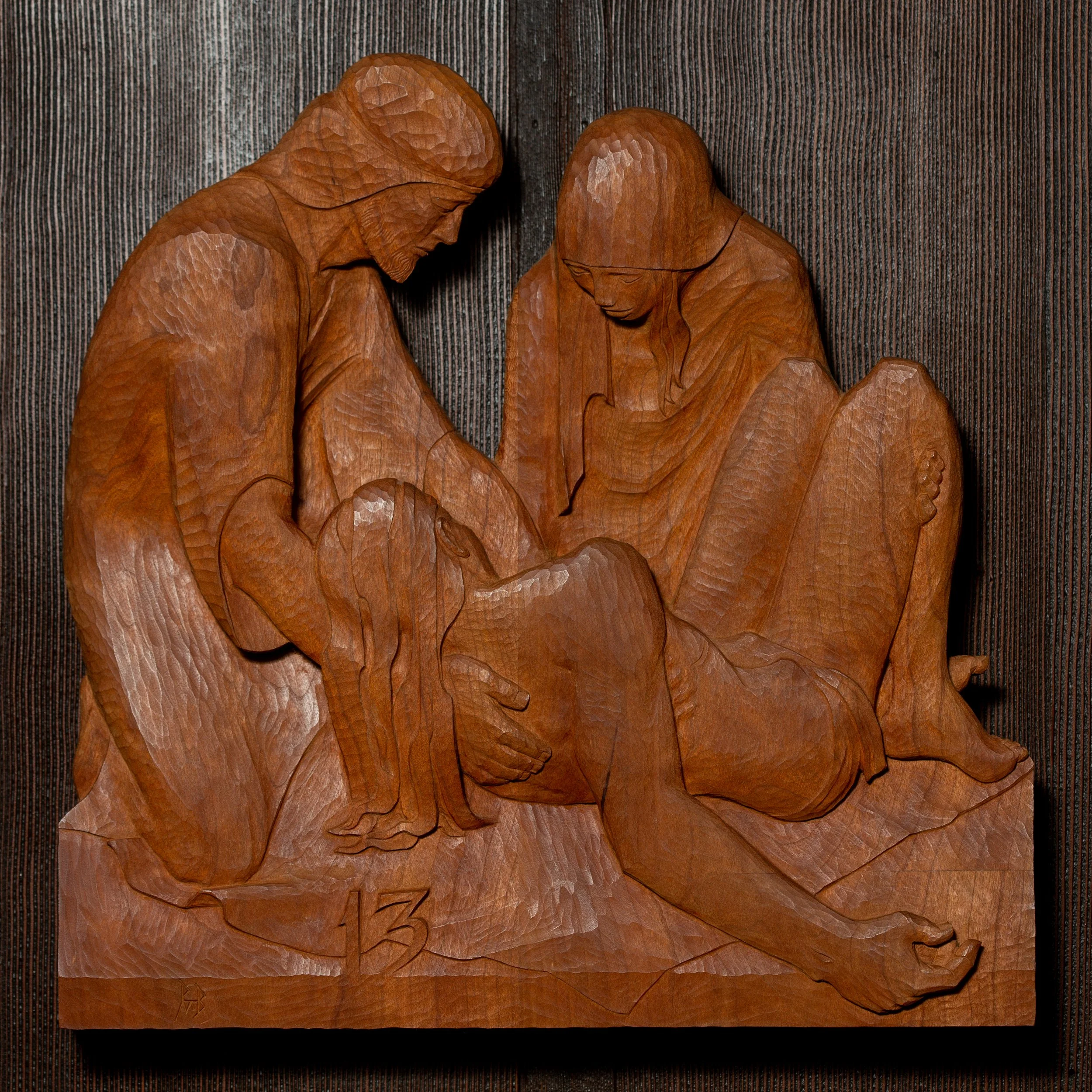
This station is known as The Deposition. It is unclear who might have been there to assist in this incredibly painful experience. I simply decided to have a male and female figure. She could represent anyone, Mary Magdalene or his mother Mary. The male figure could be any of the men who were there at the time. The relief on the female face was quite a challenge because it is in deep relief and is seen only in partial perspective.
Station 14 Jesus is laid in the tomb
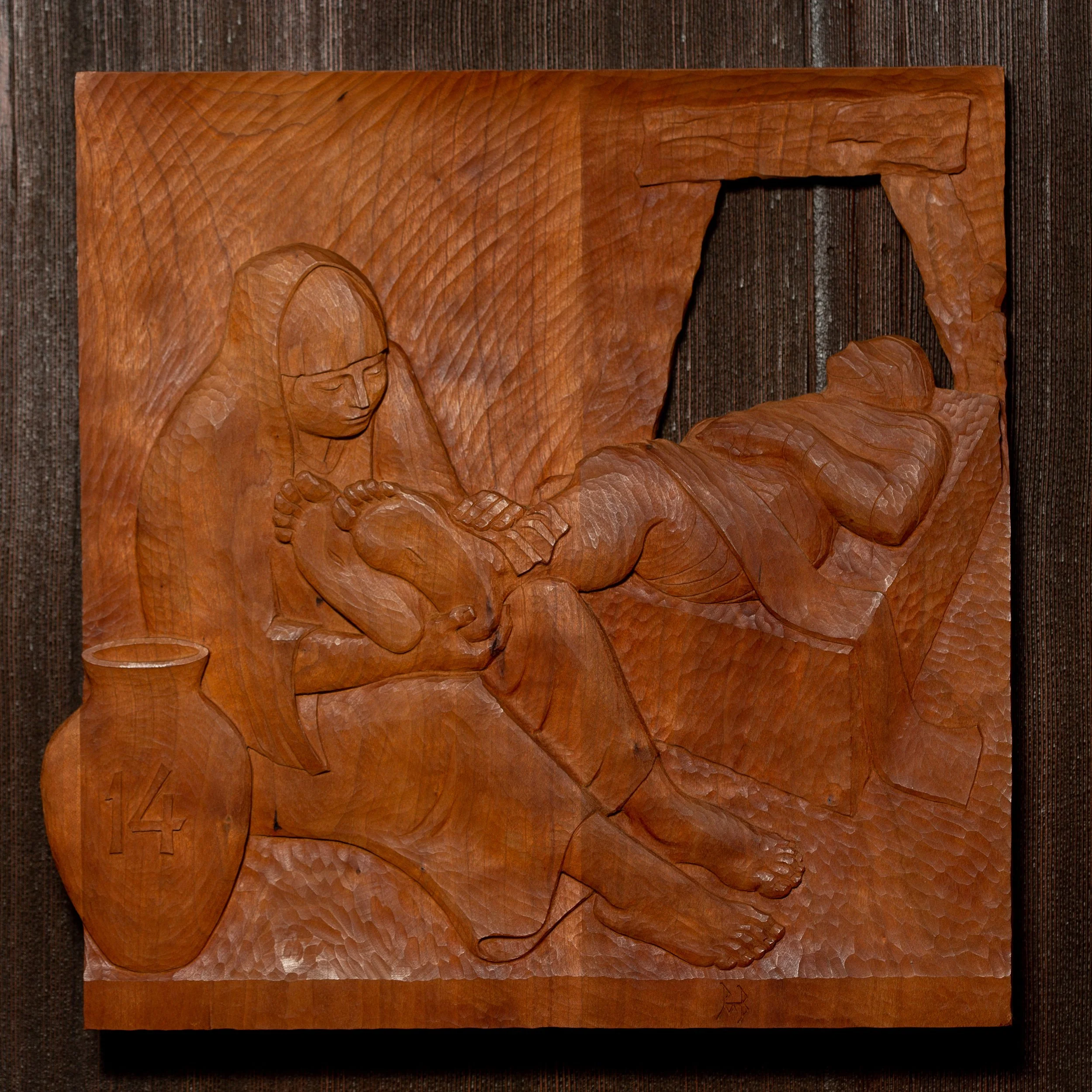
The last station is the entombment. I once more wanted to use the feet as that kind of helpless human symbol. There is something about our feet which apparently Jesus understood, particularly the activity of washing the feet, which was a common thing that was engaged in frequently. Washing the feet was Jesus’ gesture during the Last Supper. It was a common gesture, and would be the same thing as an acceptable stroking that we do amongst ourselves today. Jesus’ feet, with their brutal nail holes, receive his last human touch. Jesus is mostly covered by the entombment.
Those are the Stations of the Cross, and I would be happy to answer any question you might have.
Question: : inaudible, but the question can be deduced by Mr. Buckner’s answer.
Buckner response: There is strong evidence about the shape of these caves, and in fact the round stones that sealed these caves are still around. They are large stones that are rolled in a track. They tend to be roughly hewn out of the hillside. There was a standard architectural element of two tipped vertical members with a lentil across the top. There would have been a track like a gutter in which the large stones were rolled. I felt that this would be historically accurate, and the open living world behind the head would have been appropriate as seen from this angle.
Question: How did you feel when the stations were all complete?
Buckner response: It is always anticlimactic to finish a work because one is so involved during the process. I feel satisfied. I would let any one of these sculptures represent me and I am proud that I carved them. There are some that mean more to me sculpturally than others, but I feel as good about every single one of them as I do about any other piece of sculpture that I have done.
I suppose years will tell what these did for me as a sculptor and a human being. It was an experience that I am glad that I had, and I will never approach the fourteen stations with the kind of naïve assumption that I had when I originally began these. I thought they would be just another piece of sculpture and they aren’t. I am proud and pleased with them, but they had become more
(At this point the recording suddenly ends. However, Fr. Ted Berktold clearly remembers Paul saying that what started out as a normal professional commission took on new meaning as the carvings progressed. As Paul and his son, Matthew, grew in understanding the suffering and pain of Christ, and then grappled with how best to describe it in their carving, they drew closer together. The bond that they forged in this project changed their relationship in an unforeseen and lasting way.)