On March 25, the church will celebrate the Feast of the Annunciation when the Angel Gabriel told Mary she had been chosen to be the Mother of Jesus Christ, the Son of God. It is therefore appropriate that the Statue of Mary, carved by Les Breidenthal, is the next article in the Sacred Art in our Sacred Space project.
The Artist
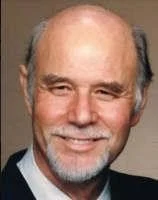
Les Breidenthal was born in 1922 in Topeka, Kansas. He joined the Army Air Corp soon after the attack on Pearl Harbor, and became a B-17 command pilot. On his second mission he was shot down over France, was captured, and spent 20 months as a POW at Stalag Luft III near Zagan, Poland, which was then part of Nazi Germany
After the war, Les returned to Kansas to attend the University of Kansas where he met Ruth Veach, a pianist who was also majoring in music. She became his accompanist and they eventually married. Les and Ruth continued their education at Columbia University in New York, completing their Bachelor of Arts and Master of Arts degrees in Music Education. Les was awarded a Fulbright Scholarship to study voice in Rome, Italy, where they lived for 6 years.
In 1957 they moved to Wichita, Kansas, where he began his teaching Career at Friends University. In 1962, the family moved to Ann Arbor, Michigan, where Les earned a Doctorate in Musical Arts at the University of Michigan. He taught at Southern Illinois University before joining the faculty at the University of Oregon School of Music where he spent the rest of his academic career. Les performed in numerous recitals throughout his career, always accompanied by Ruth at the piano. In addition, she was the organist at St. Mary’s for over twenty years.
In addition to his love of music, Les was a very talented artist. He loved to draw, paint and carve sculpture in wood, clay and soapstone. He was kind, generous and had quite a sense of humor.
The Statue of St. Mary
In 1975, Les was commissioned by St. Mary’s Episcopal Church, of which he and Ruth were long-time members, to sculpt a statue of St. Mary the Virgin, the Patron Saint of the church. By October of that year he was in the process of sculpting the figure, which he had begun by sketching ideas and solutions on the back of the Sunday worship bulletin as he sat in the choir and listened to the sermon.
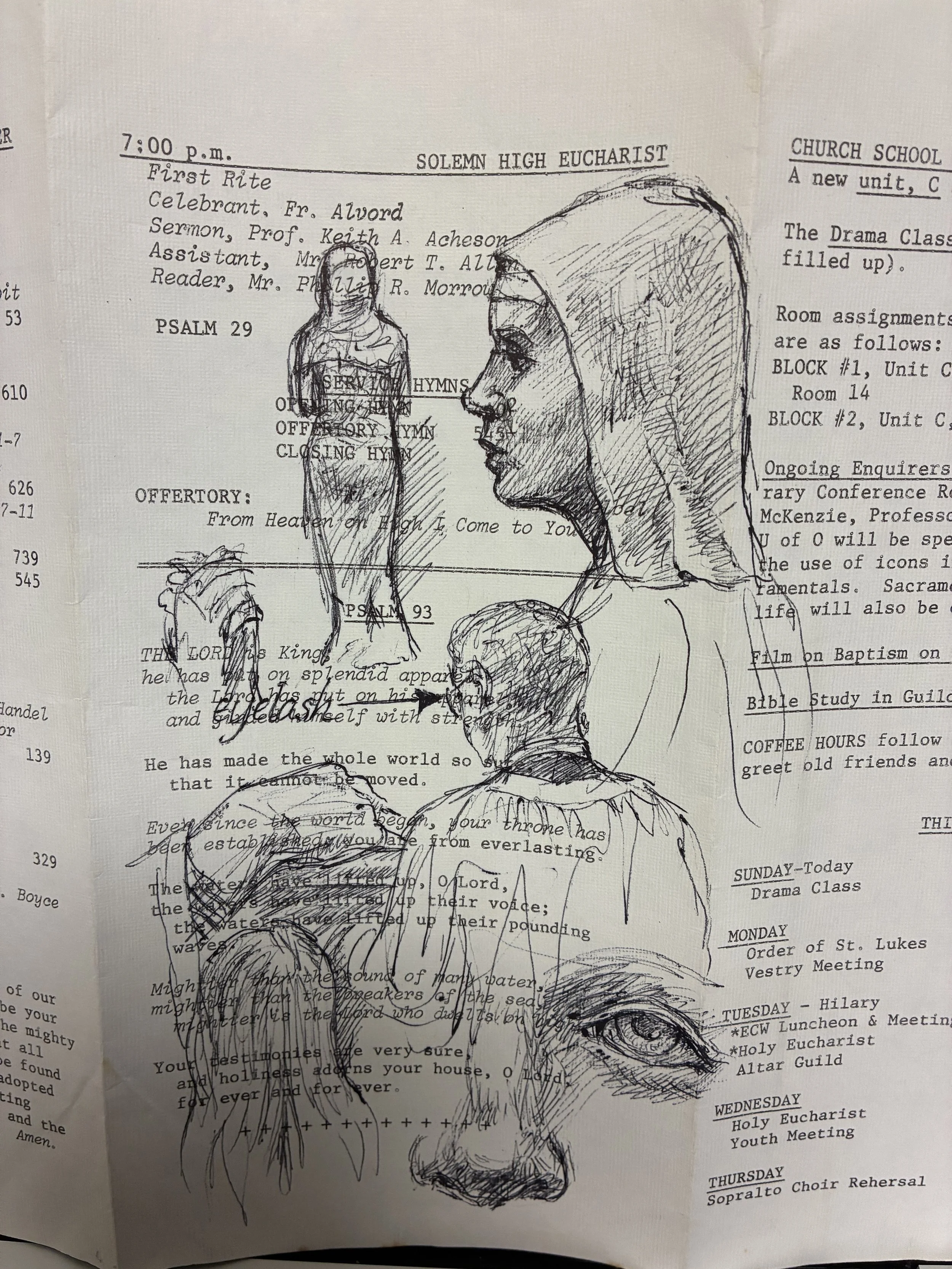
Pictured above: Sketches of the Mary Statue on a worship bulletin.
Les envisioned Mary as a young girl, calm and sturdy, from a common working family, with strong legs and back visible under her robe. Her hands are held together in the front of her body, not praying, but signaling expectation. Les’s daughter, Anne, 14 at the time, stood voluntarily for several hours one afternoon with her hands folded in front of her as her father sketched them.
In November of 1976, three men loaded the statue of Mary into a pickup and delivered her to the Narthex of St. Mary’s Episcopal Church, where she stayed until a renovation of the church narthex in 1991. At that time she was moved to the northwest corner of the Nave where she remains.
Les was bothered that the statue simply sat on the floor instead of being prominently displayed under a baldacchino, a canopy that covers a statue, throne, or altar. So in 1985 he began carving the baldacchino. It took over 400 hours to complete, and involved hundreds of pieces of wood, some of which were only inches in length. Les was given invaluable assistance in sawing the wood by David Hess, an architect and member of St. Mary’s Liturgical Choir. The curved top of the baldacchino fit together like a jigsaw puzzle. His daughter, Anne, said “It was a complicated design with a lot of measurements and lots of pieces to cut and glue together. He told me carving the baldacchino was more challenging and difficult than carving Mary.”
Every year when the parish celebrates St. Mary’s Feast Day in August, the Gospel is processed to the statue of Mary where her own utterance is proclaimed: “My soul doth magnify the Lord.”
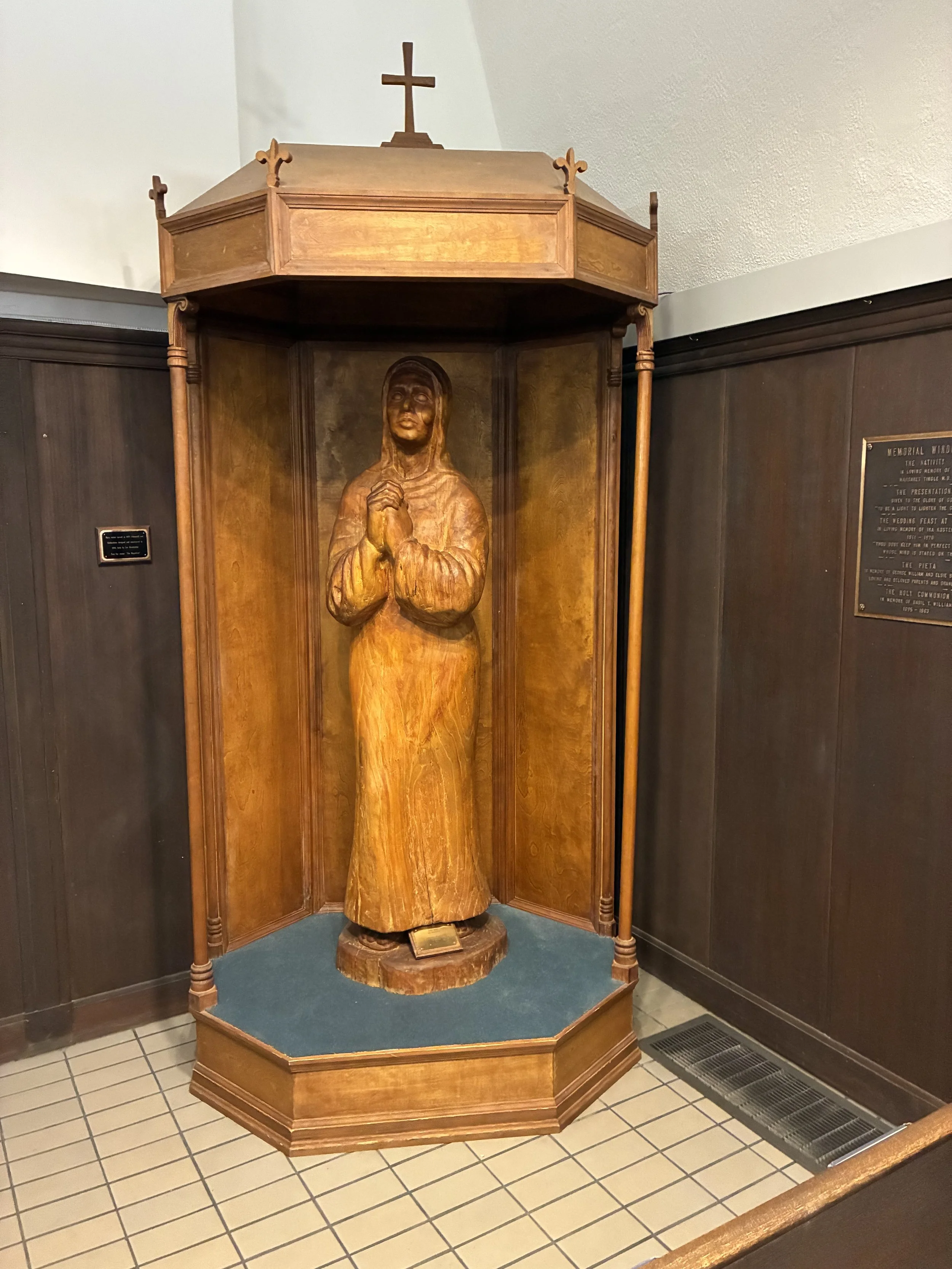
Pictured above: Statue of St. Mary the Virgin and baldacchino carved by Les Breidenthal.