The Artist
In May, 1889, Daniel Loveridge was installed as the Rector of St. Mary’s. He was 65 years old, and came from the Diocese of Albany, NY. He served at Trinity Episcopal Church in Portland for a few months before coming to St. Mary’s.
Fr. Loveridge and his wife lived in Glenwood on the property that is now Roaring Rapids Pizza, and from there he rode his bike to church, which was then located at 7th and Charnelton. He was an accomplished scholar of Hebrew and Greek, and also a talented wood carver. Among his many gifts was the altar that is now in St. Mary’s side chapel.
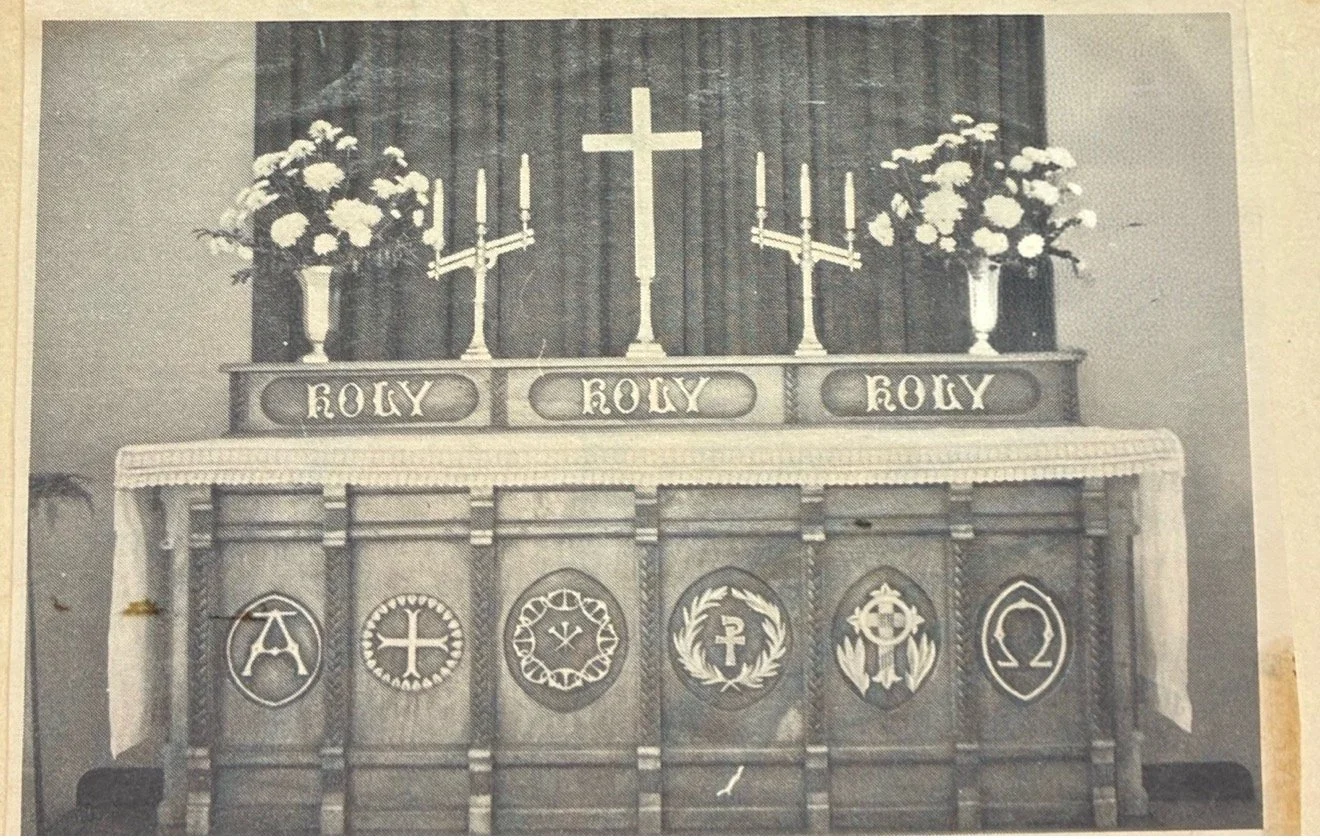
The photo is from a 1963 Register Guard article that describes the history of the Loveridge altar. The altar was given to St. Thomas in 1958, where this photo was taken.
Fr. Loveridge did the carving of the altar in a shed in the back of the church property. It is made of Oregon maple and California redwood. The front consists of six panels of white maple separated by strips of highly polished redwood.
The six designs carved on the altar are, from left to right:
1. Alpha: The Greek letter A, the beginning, the first. The phrase, I am the Alpha and the Omega (the beginning and the ending), was spoken by Jesus.
2. Moline Cross: This cross is characterized by forked prongs that terminate at each of the four arms. The term 'Moline' comes from the Latin molere 'to grind' and molinum 'mill'. This is because the shape of this cross is similar to the iron bar (rind) that supports or secures a millstone. The Moline Cross has several religious meanings. One is the reference to Jesus as the bread of life and spiritual nourishment. The other is that the eight points on the prongs represent the eight Beatitudes. The circle that encompasses the cross signifies wholeness and eternity.
3. Crown of thorns and nails: This carving represents the woven crown of thorns that was placed on the head of Jesus during the events leading up to his crucifixion. Jesus’ captors intended it both to cause pain and to mock his claim of authority. The three nails represent the piercing of Jesus’ hands and feet on the cross.
4. Tau Cross: This cross is created out of the Greek letters tau and rho. The capital tau, or T, is similar to our English T. The capital rho, or R, is written like our letter P. It is a pictographic representation of a crucified figure hanging on a cross

Loveridge surrounded the Tau Cross on the altar with olive branches, the symbol of peace.
5. Fleury Cross: The Fleur-de-lis, with its three petals at the ends of the four arms of the cross, represent the Trinity. It is foliated, or adorned with a vine with three leaves which reinforce the image of the Trinity. As in the Moline Cross, the circle signifies wholeness and eternity.
6. Omega: This the final letter in the Greek alphabet, and is often used to denote the last, the end. It is the sixth image on the Loveridge altar, and it is the bookend to the Alpha symbol that is the first image on the altar
Fr. Loveridge carved a retable and credence table with similar workmanship and design as companions to the altar. A retable is a framed altarpiece, raised slightly above the back of the altar. (It can be seen in the photo of the altar, above.) The retable had three panels with the word HOLY carved in each. As with all the carvings on the altar, it was raised and gilded in gold. There was also a credence table, a small side table that holds the elements for use during the celebration of communion. Both the retable and credence table have been lost.
The altar was dedicated on Easter Sunday in 1897 as a gift to the Parish by Fr. Loveridge and his wife. It was moved to the second church at 7th and Olive built in 1889, and to the current St. Mary’s site at 13th and Pearl in 1938. In 1958 the altar was given to St. Thomas Episcopal Church, a parochial mission of St. Mary’s that was founded in 1956.
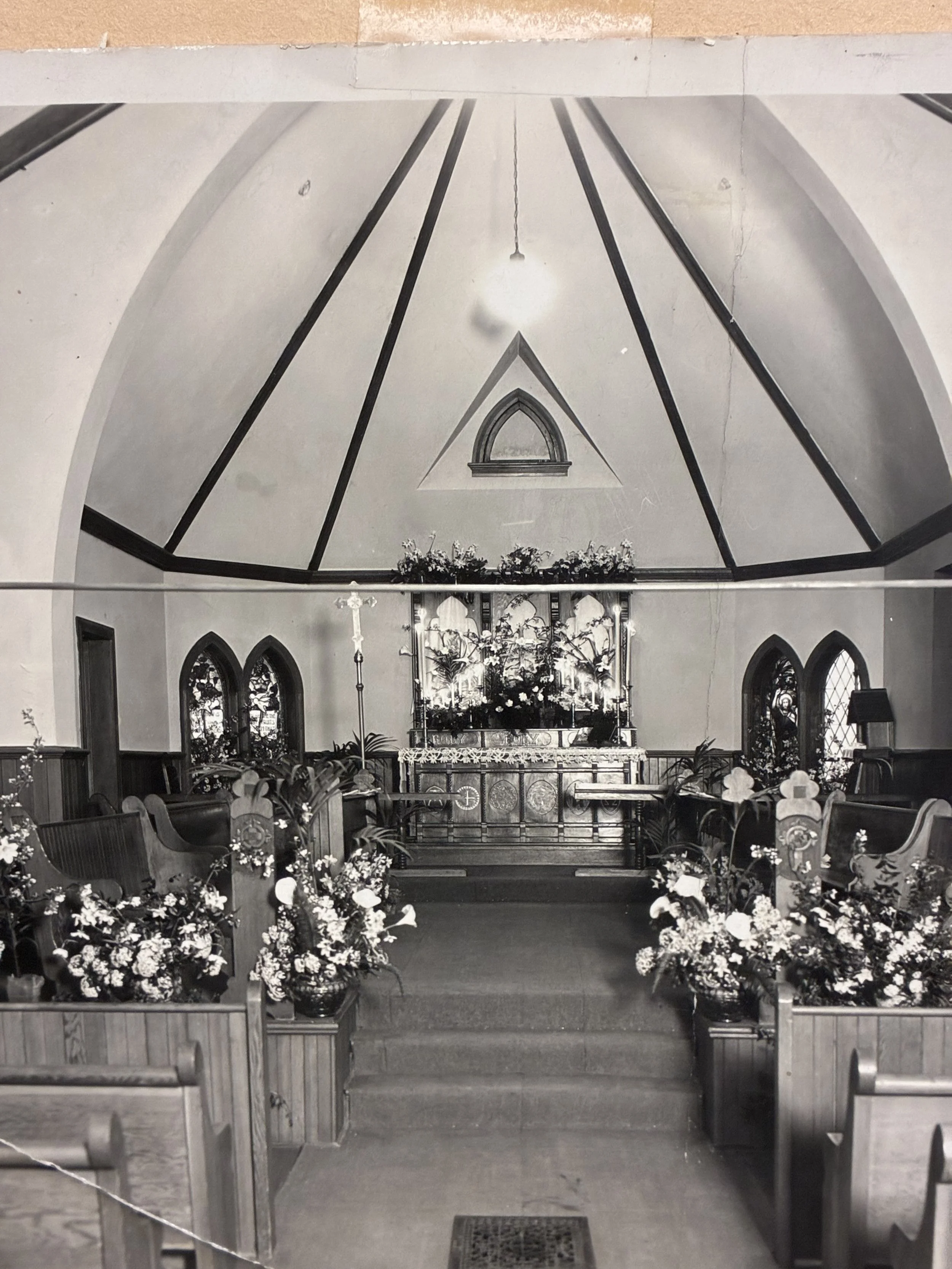
The Loveridge altar in the second St. Mary’s Church at 7th and Olive.
Sometime in the 1970s, the altar was moved to Carman Hall at the Triangle Lake Conference Center, which was operated by The Episcopal Diocese of Oregon. In 1996, the altar was returned to St. Mary’s and placed in the side chapel. In order for the altar to fit in the smaller space, the two end panels, the Alpha and Omega, were cut off and repositioned at the sides of the altar. There was a Service of Rededication on Thanksgiving Day, November 27, 1997, attended by members of the Loveridge family
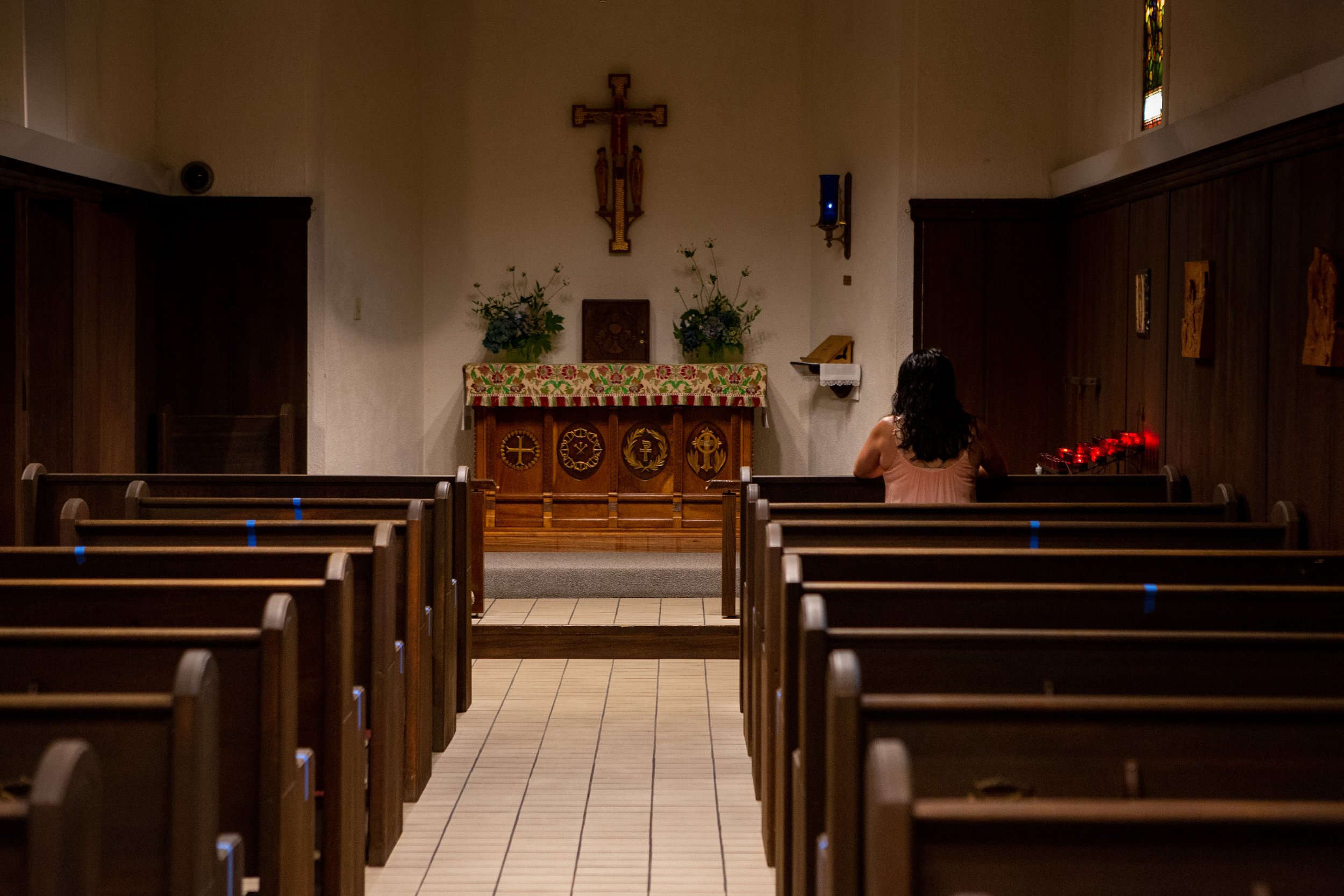
The Loveridge altar in the side chapel at St. Mary’s, 13th and Pearl.
Fr. Loveridge died on November 14, 1908, at the age of 83. He is buried at the Eugene Pioneer Cemetery
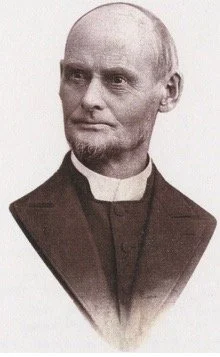
Fr. Daniel Loveridge, 1824-1908