Stained Glass Windows
In 1973, there was an extensive remodeling of the Nave of the church. The altar was moved from the back of the east wall to the front of the chancel, allowing the Priest to face the congregation from behind the altar during the Eucharist. The choir pews, which had lined the chancel area and faced the center, were moved behind the altar so they were facing the congregation. Glass block windows were installed in the north wall of the Nave, with the assumption that stained glass memorials would eventually be installed.
That was indeed the case. In 1975 the firm of Wippell Mowbray Church Furnishing Ltd, of Exeter, England was selected to design and execute the five windows to be installed in the Nave and Chancel. The artist was James A. Crombie (1913-2000), who studied at the Royal College of Art from 1934-8. After the war he worked as a designer for the Abbey Studio in Edinburgh until he relocated to England in 1963.
The four Nave windows depict events involving Christ and St. Mary: The Nativity, The Presentation in the Temple, The Wedding Feast at Cana, and the Pietà. The fifth window, located in the Chancel, is on the theme of the Eucharist. The stained glass windows were dedicated on Sunday, November 7, 1976. While the original plan was to replace the glass blocks with the stained glass, it was decided to keep the glass blocks in place. Not only did this provide a level of security and protection for the stained glass, it had the surprising feature of enhancing the colors of the stained glass.
All of the stained glass windows are vibrant colors of green, blue, deep purple, red, and gold. Only the figures of the Holy Family--Joseph, Mary, and Jesus--have halos, a symbol that depicts holiness and divinity.
The Nativity
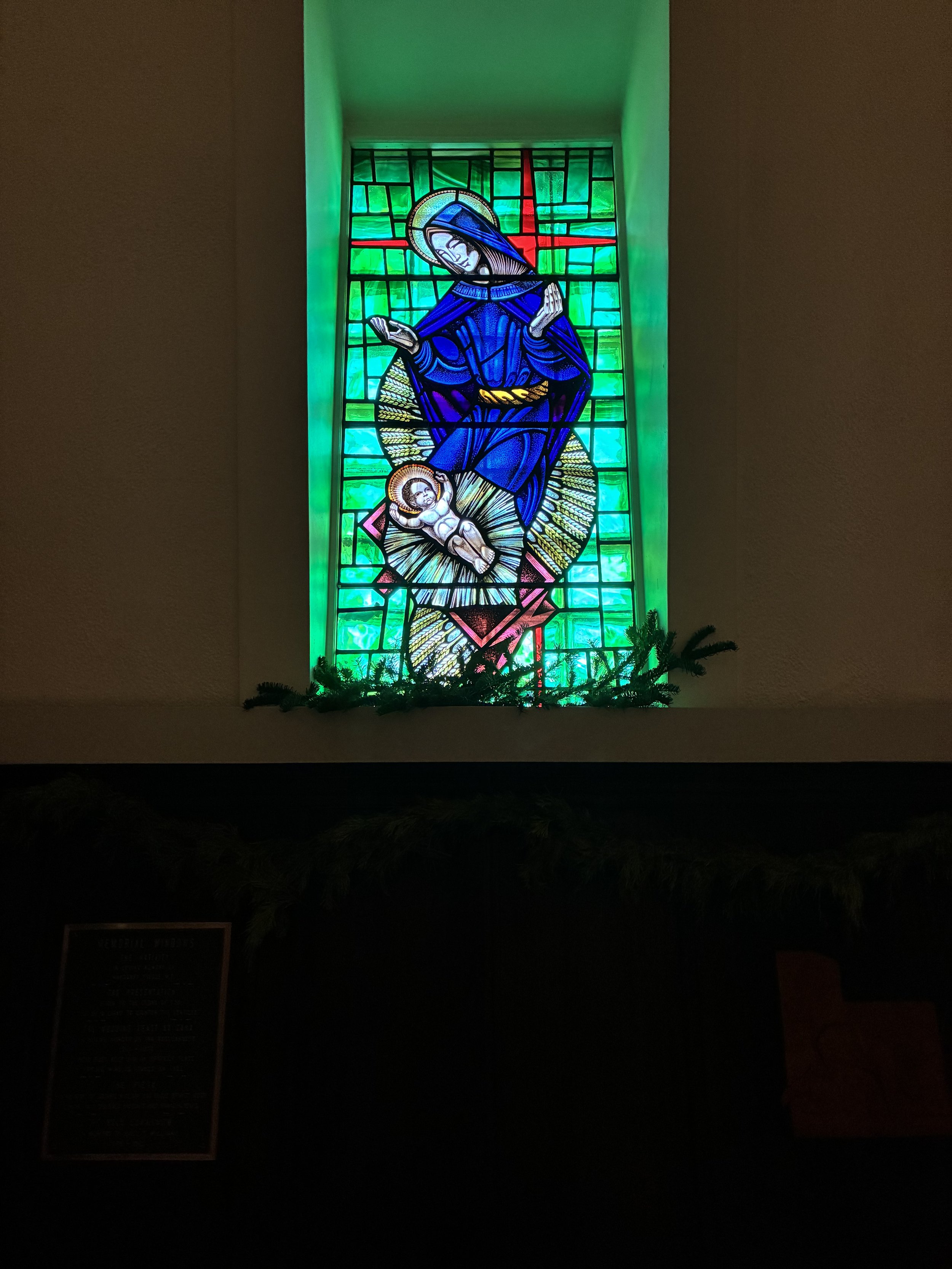
The Nativity, the scene of the birth of Christ, is of Mary and the baby Jesus. Mary’s robe is the vibrant color known as Marian blue. In Medieval and Renaissance Europe, the blue pigment was derived from the metamorphic rock lapis lazuli, a stone imported from Afghanistan of greater value than gold. It was an expression of devotion and glorification to swath the Virgin in gowns of blue. Marian blue became a visual code in religious art: where there is deep blue, there is the presence of the Mother of God. Even when other sacred figures are portrayed in similar shades, it’s never the same blue. Marian blue was darker, purer, more expensive. It was a reserved visual language. Marian blue was not shared with anyone—not with the angels, not with the saints, not even with Christ.
The Presentation of Jesus at the Temple
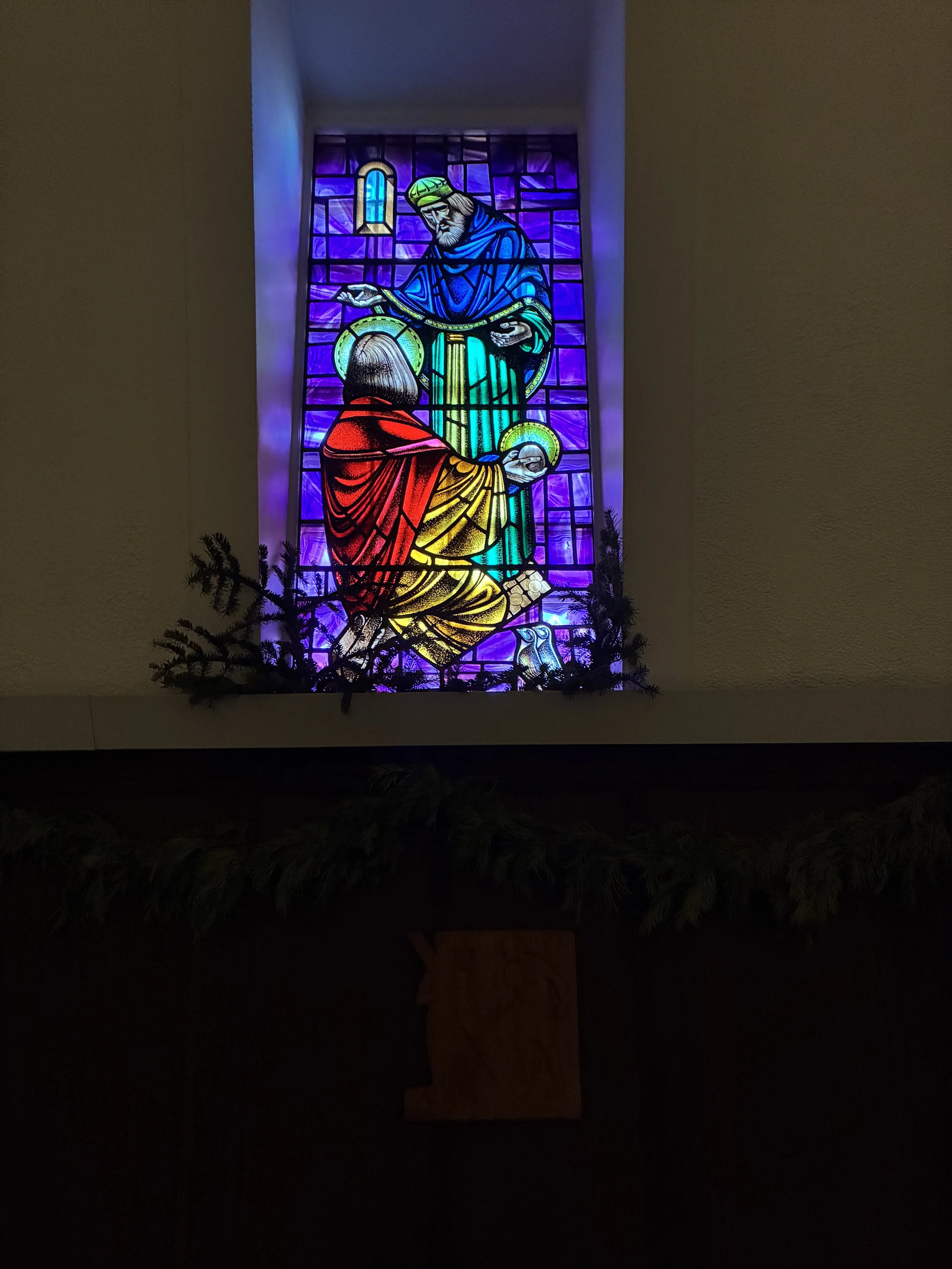
The Presentation of Jesus at the Temple is an early episode in the life of Jesus Christ that is celebrated by many churches forty days after Christmas. According to the Gospel of Luke, Mary and Joseph took the infant Jesus to the Temple at Jerusalem in obedience to the law of Moses. The law requires the sacrifice of a lamb, but two turtle doves or young pigeons are acceptable if the family is poor. During the presentation, two prophetic figures, Simeon and Anna, recognize Jesus as the Messiah.
The window shows Simeon, in high priest garb, blessing the child Jesus, who is in the arms of Joseph. The two turtle doves are visible in the lower right hand corner of the window. This Presentation at the Temple is celebrated in Christian tradition as a moment of dedication and prophecy, highlighting the fulfillment of Jewish law and the recognition of Jesus as the Messiah.
The Miracle at the Wedding in Cana
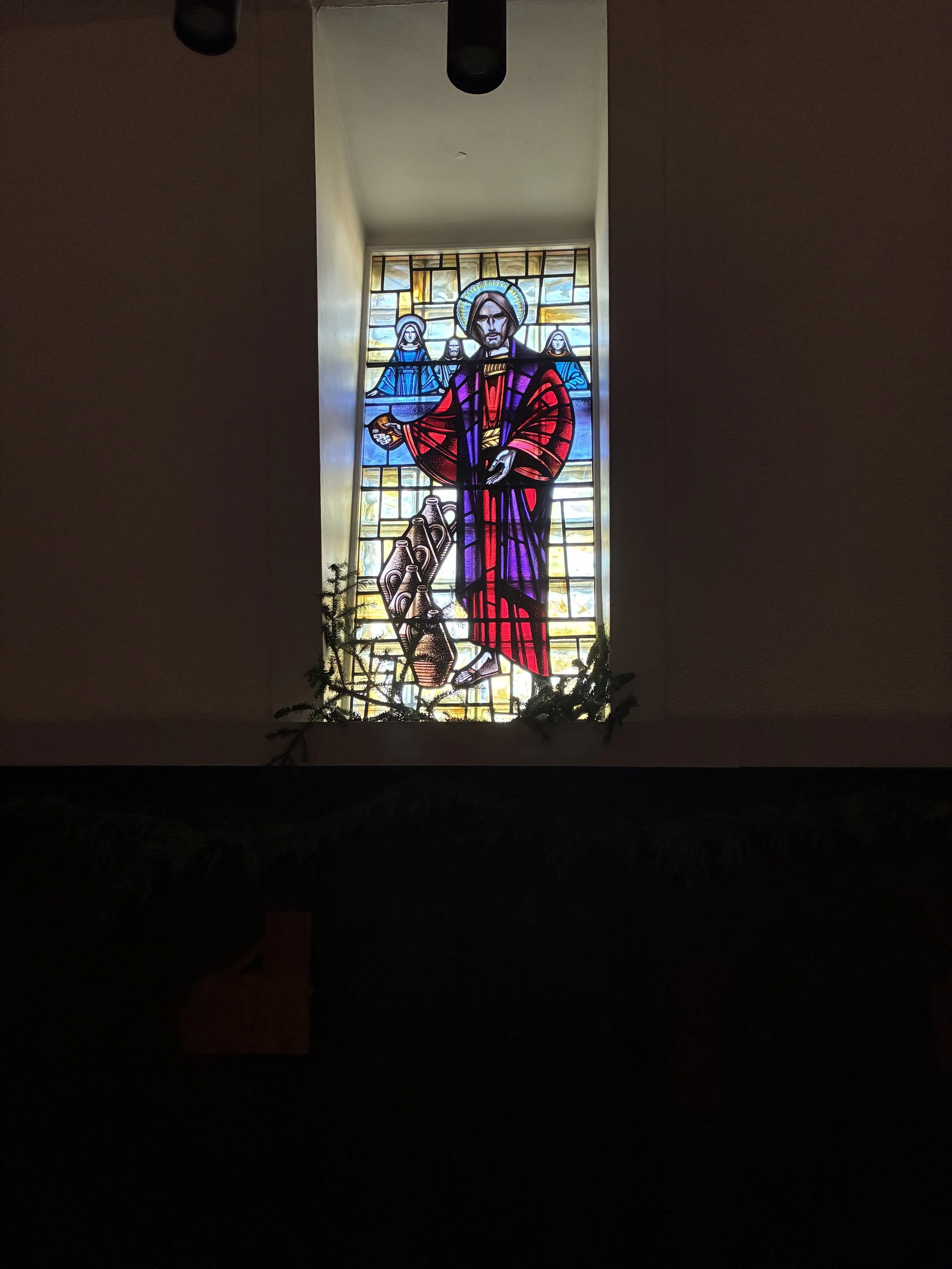
The Wedding at Cana is a depiction of Jesus’s first miracle in which he turned water into wine. The narrative begins with Jesus, his mother Mary, and his disciples attending a wedding celebration. Weddings in Jewish culture were significant social events, often lasting several days. During the festivities, a problem arose: they had run out of wine. In Jewish tradition, running out of wine at a wedding would have been a major social faux pas, potentially bringing shame to the host family. Mary, aware of the situation, approached Jesus and informed Him, saying, "They have no more wine". At first reluctant, Jesus eventually instructed the servants to fill six large stone jars with water. After the jars were filled, He told them to draw some and take it to the master of the banquet who discovered the water was now wine of an excellent quality.
In a sermon preached by Rev. Bingham Powell on January 16, 2022, he explains the significance of the miracle:
In today's reading [about the wedding at Cana], we see that God cares about our joy, about pleasure, about fun. All too often we think about religion as serious business. It is, but one of the things that God seriously cares about is joy. God delights in our delight. When God became Incarnate in the person of Jesus, God did weighty and grave things certainly, but God also had fun. Jesus invited himself over to meals a lot. And one of the great criticisms of Jesus at the time was that he was a glutton and a drunkard. He liked the parties.
Here he is at one in Cana of Galilee and they have run out of wine. So Jesus makes more. Not just a little bit and not just the cheap stuff. He makes the good stuff and he makes a lot of it. He makes sure the celebration is not going to end for a good long while. God cares about the celebration. God cares about joy. These are not ancillary matters in a good and holy life. Playfulness matters. Fun matters. Joy matters.
The window depicts Jesus standing near the water jars, with Mary and two other figures in the background
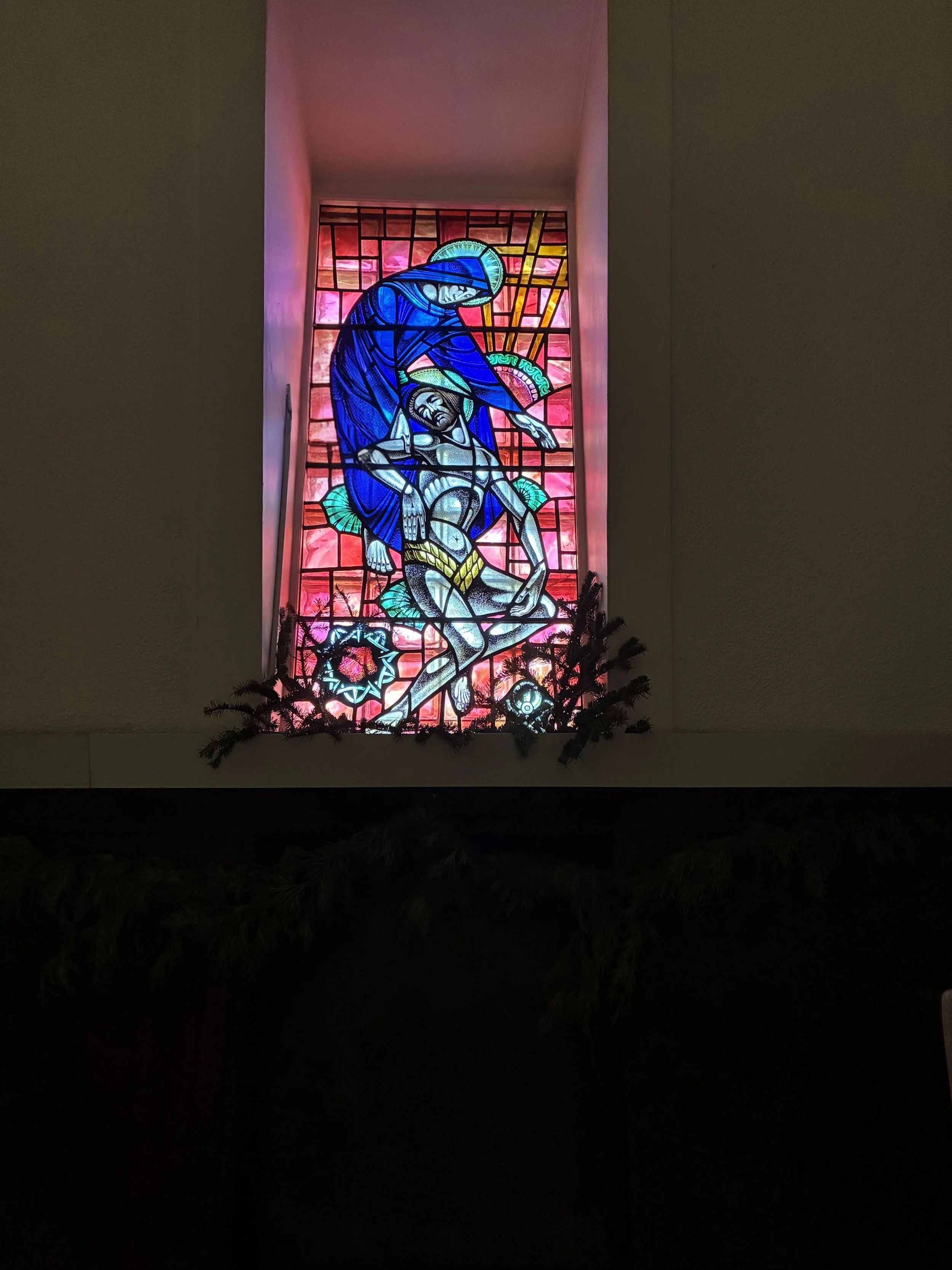
The Pietà
The Pietà is a subject in Christian art depicting the Blessed Virgin Mary cradling the mortal body of Jesus Christ after he is taken down from the cross. In this window, Mary is again dressed in Marian blue, identifying her as the Mother of God. The crown of thorns is in the lower left corner of the window. The three nails used to crucify Jesus are in the lower right corner, although partially obscured by the Christmas greens that decorate the windows during the season. This is one of two windows that only show the figures of Jesus and Mary. The other window depicting this intimacy of mother and son is the Nativity.
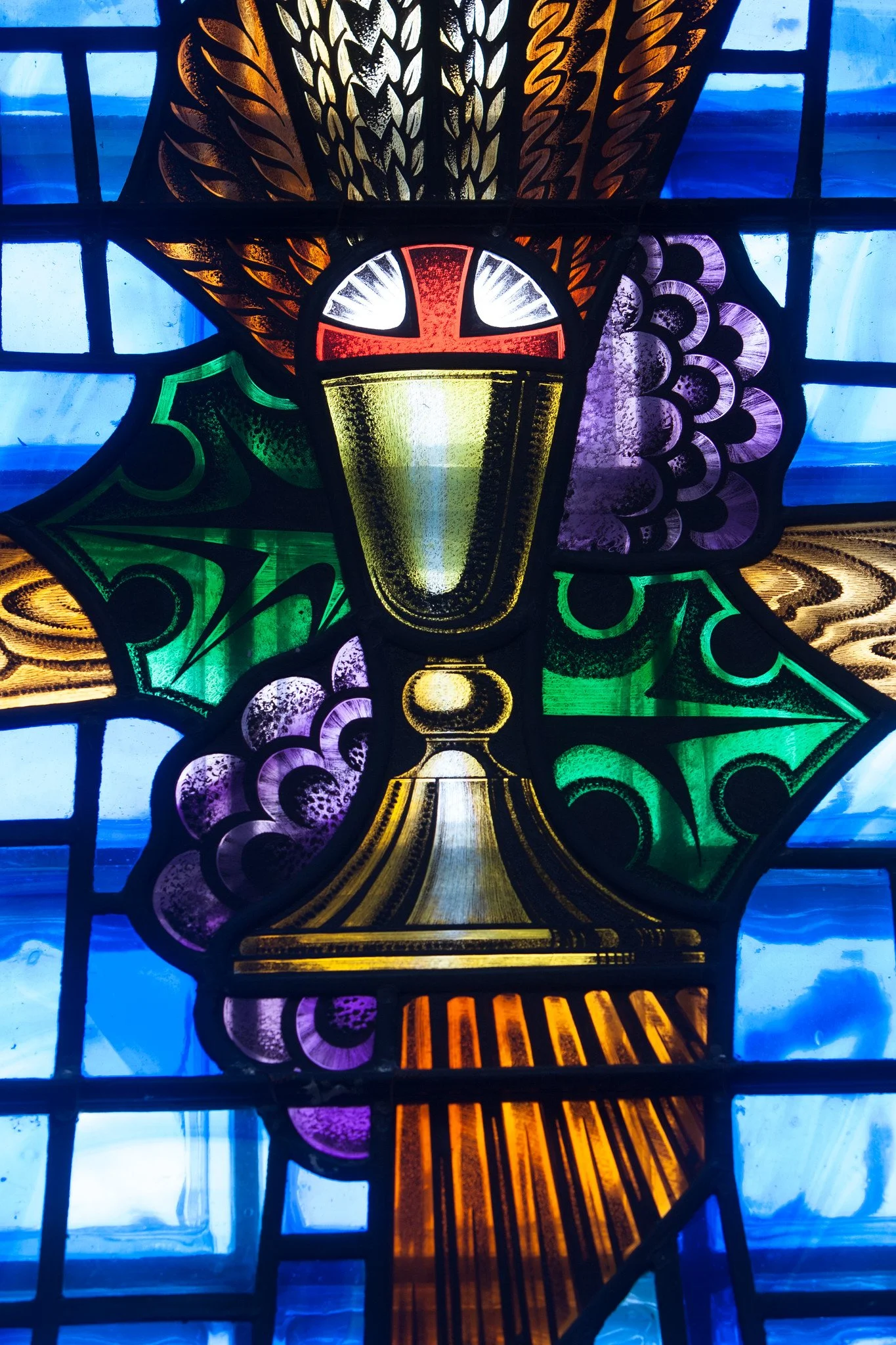
The Eucharist
The Eucharist window is placed in the Chancel near the altar where the Holy Communion takes place. It is a visual representation of the elements of the Eucharist: sheafs of wheat representing the flour for the communion wafer; grapes representing the wine which is the Blood of Christ, and the chalice which holds a cross superimposed on a communion wafer, signifying the Body and Blood of Christ.