The Artist
Beatrice (Bea) Pierson was a long time member of St. Mary’s. She joined the staff in the volunteer position of “Artist in Residence” in 1962. Bea’s artistic talents extended into many areas: fiber arts, woodworking, visual arts, and bookbinding. In the late 1970s, the corner of the basement was known as the Craft Center, which included a kiln, and it was there that Bea created many of the items for St. Mary’s. In 1974, her projects included twenty-five crosses for the Acolytes, the rebinding of hymnals used by the choir, one hundred enameled crosses and medallions that were sold at the Christmas Bazaar, an Easter screen on the pediment above the altar, and an altar frontal for Pentecost.
Carolyn Bergquist was one of the children who participated in the classes and activities that Bea had for youngsters at St. Mary’s. Carolyn says, “I remember Bea Pierson with great affection. As youngsters, we would go down into the basement where her studio was and create enameled copper pendants and things. Learning about the kiln was incredibly cool (haha), but even more, she taught us so much about the meaning of symbols used in the church. She was a gifted church artist and teacher; there were so many gentle explanations about symbols on vestments, altar linens, church art, etc. She took the mystery away from the material art in the church and also deepened the theological significance and mystery for us.”
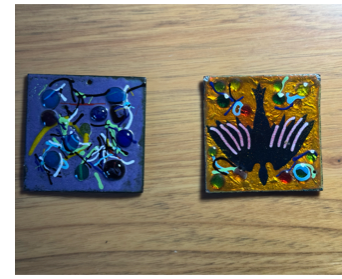
Enameled pieces Carolyn Bergquist created in classes with Bea Pierson.
The Tabernacle
In 1969, Bea carved a Tabernacle that was installed on the altar in the chapel. A Tabernacle is a liturgical furnishing that holds the consecrated Host after Mass. The Tabernacle is normally made from precious metals, stone or wood, and is lockable and secured to the altar or adjacent wall to prevent the consecrated elements within from being removed without authorization. The word tabernacle means “dwelling place.” The Episcopal Church believes that the Eucharist contains the real presence of Jesus, and thus the term tabernacle refers to the place where Christ dwells.
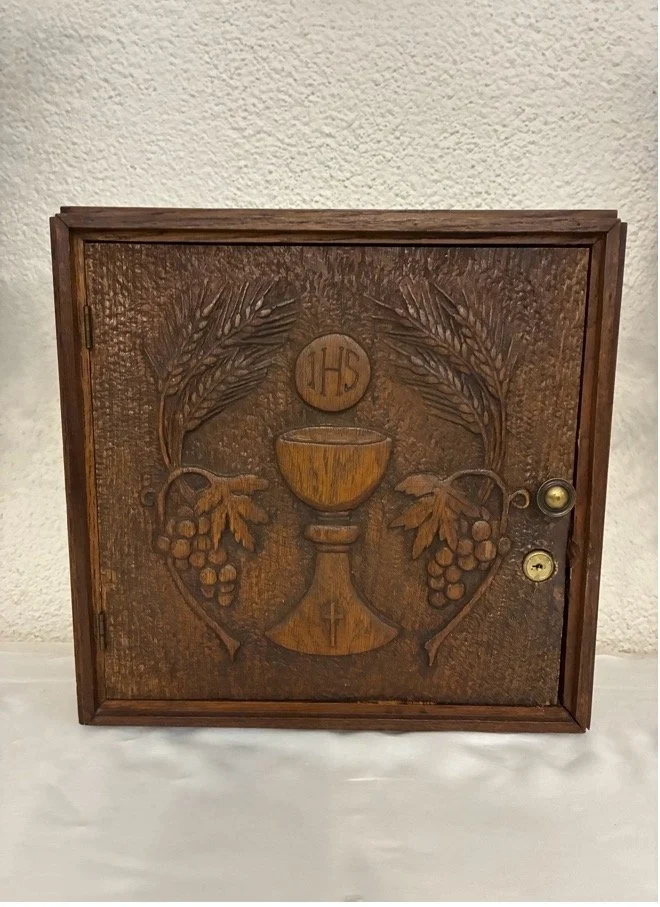
The Tabernacle Bea Pierson carved for St. Mary’s.
Bea used several symbols of the Christian church in her carving. The "IHS" in the medallion above the chalice is derived from the first three letters of "Jesus" in Greek (ΙΗΣΟΥΣ). It is often interpreted as "Iesus Hominum Salvator," meaning "Jesus, Savior of Men." The chalice is a footed drinking cup with a stem, used to hold the sacramental wine of the Eucharist. The grapes represent the wine, the Blood of Christ. The wheat stalks represent the flour that is used in making the wafer for communion. It also makes reference to Jesus as “the bread of life.”
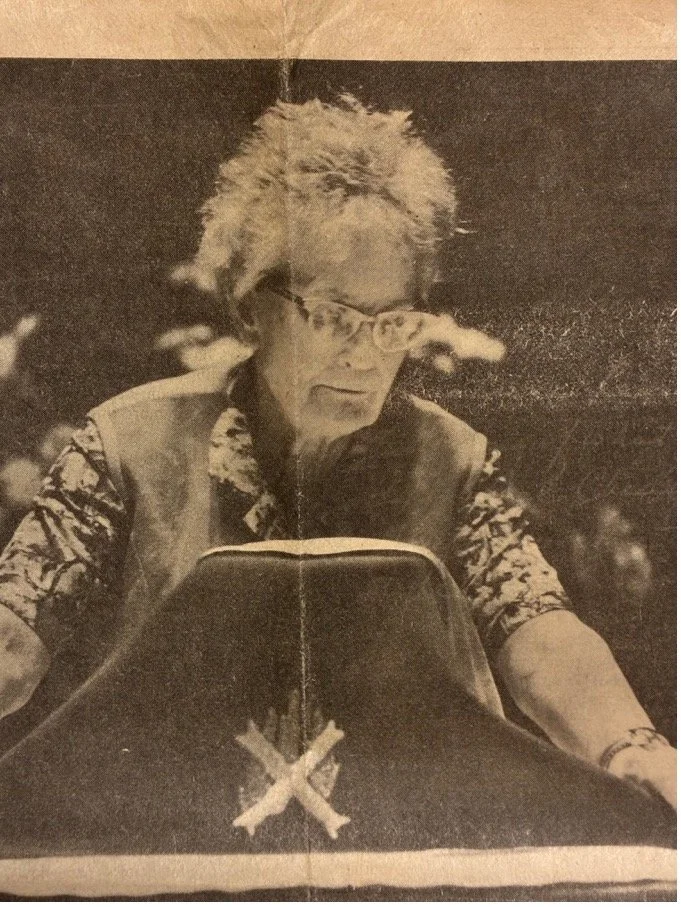
A photo from the February 14, 1976 Register Guard picturing Bea Pierson setting the Altar with a Chalice Veil that she designed and embroidered.
Bea Pierson died in 1989, but her legacy continues. In addition to the Tabernacle, which is used every Sunday at St. Mary’s, she requested that funds from her estate be used for liturgical arts. The money the church received was used for the second tapestry woven by Cecilia Blomberg, an appropriate memorial since Bea had served on the committee which originally chose the tapestries and the artist.