“Oh that was beautiful! What a gift!” people gasp after a musician concludes a breathtakingly moving performance. “Wow, that was awesome!” spectators exclaim after an athlete executes a seemingly impossible move on the field or on the court. “How can anyone do that?” We’re used to talking about people who live in the spotlight as being extraordinarily gifted, the years of dedicated practice that have gone into developing that gift notwithstanding. However, as we hear in today’s epistle to the Romans, just as a body is made up of many parts each with its own purpose, so as members of one body in Christ, that is as members of a Christian community, we are each blessed with our own particular function, our own particular gifts which we’re called to share in order for the body, the church, to thrive, to grow ever closer to being the community God intended it to be.
When Paul talks about gifts we realize quickly that these aren’t the ones from which great performances arise, rather they’re the ones that enrich our lives on a day-to-day basis. They’re the gifts that are too often taken for granted rather than as something important to the recipient of that gift as well as everyone around them. Take from the list in today’s Epistle, for example, the gift of teaching to the teacher. I spent 32 years teaching chemistry and physics to teenagers. I treasure my memories of the experiences I had with my students over the years but none of those memories is quite as special as one from about two and half years ago. My seven-year-old friend Connor was four and a half then, and seemed to me, as much as I knew about such things, like he was ready to read. So I bought a box of Bob books and one day asked if he’d like to learn to read. YES! came the reply. So across the cul de sac we went to my house where I pulled out the first book: Matt. Connor sat on my lap as we read the book. Matt sat. Sam sat. Matt and Sam sat. Matt sat on Sam. Uproarious laughter - funniest thing he’d ever heard. Sam sat on Matt. The End. Shall we read it again? Yes. After the second reading, would you like to read it to Mommy? Yes! So back across the cul de sac we ran. We burst in the front door, and not seeing his mother Connor beamed around the corner down the hallway to the bedrooms calling, Mom, I can read! Connor of course had memorized the book that day, but we made our way through nine boxes of Bob books over the next year, which lead to him taking on more and more complicated material so that when he started kindergarten last fall he could read at a level that blew my mind. Teaching is a gift, and it is a gift from God that rewards the teacher, the student, and everyone who cares about them.
That’s how it is, though, with gifts of the spirit. Their effect spreads like ripples in a pond, touching others in an ever widening circle. For example, I’ve always been impressed during my time in Cuernavaca with the patience of the entire diocesan staff with the participants in the language immersion program. Students invariably run the gamut from those who are so impatient to blurt out what they want to say in this language they’re trying to learn that they don’t bother to use any of the grammar they’ve just been studying in class, to those people who are trying so hard to remember everything they’ve been taught that it seems likely the second coming will arrive before the end of their sentence. No matter. The staff does their level best to understand what every person is trying to say every time. Over time, students invariably learn to be more patient too, both with each other and with themselves. The anxiety that is almost palpable the first couple days begins to dissipate. All of this happens I believe because there is a generosity of spirit present in that place that permeates everything that happens there.
So often in this country we associate generosity with money, and there’s no doubt that money is what makes all sorts of things possible. During our second week Bishop Enrique shared in a small group discussion he was leading that their diocese desperately needs to repair the roof of the diocesan center and also have the building painted, with all the prep work that that would entail, and that the cost for the two projects would be about $45,000 US dollars, an amount completely beyond anything they can afford. I couldn’t help but remember how we, a single congregation, not a diocese, raised a quarter of a million dollars in as I recall about two weeks when word went out during Covid that we needed to put in a new HVAC system in order to be able to worship in this space again. Personally I couldn’t write a check fast enough, given how much time I’d spent in vestments on sweltering summer Sundays over the years longing for the day we might have air conditioning in here. I don’t mention this to in any way imply that I feel guilty about enough of us having resources available to make the HVAC system a reality, but only that I think for a lot of people in this country offering financial support seems like as much as we need to do. It seems like perhaps it takes living in a place where there simply isn’t much money to realize how much we humans have to offer each other that has nothing to do with financial resources.
Going back to my friends in Cuernavaca, they are so inherently generous with their time, their energy, their very selves that they create an environment that changes people. I don’t know how else to say it. People who, yes like me, are used to being responsible for so many things, so many people, suddenly find ourselves as the ones being cared for. Moreover, we’re being cared for by people who unlike those of us attending the school, haven’t left their jobs and day to day responsibilities behind. Rather, they deal with all of that in those moments when they aren’t going out of their way to be hospitable to all of us. They never seem to be too busy to answer a question, to fix something not on the menu of the day for someone having intestinal distress, or to deal with an air conditioner not working properly or to dash out to buy a birthday cake for someone having a birthday. They are just so kind, and to hark back to Paul’s list of gifts, they are unfailingly cheerful. I was struck initially in reading Paul’s list that the gift to those who are compassionate is cheerfulness. I’ve always associated compassion with helping those in need, those who are suffering and for that reason associated compassion with sadness. But thinking about it, who needs someone to bring joy into their lives more than someone who is suffering or in need? I remember vividly three years ago when roles were reversed in Cuernavaca. A beloved older sister of Anita and Ave, a sister who had arrived to help Anita when her first child was born thirty-one years earlier and never left, and Ave’s favorite sister, the one she could always talk to, got up on July 5th, went to the bathroom, came back, turned on her television to watch the news, and died. When I arrived three weeks later both sisters were utterly distraught, yet they had of course done everything that needed to be done to be ready for our group. Still, during those two weeks we were the ones who cared for them. We held a special service where we encircled them and laid hands on them as we prayed for them in their grief. Both sisters told me afterwards that that had been a turning point for them, that somehow a great weight had been lifted off them. Yet even in the midst of pain there was still so much laughter that year too. And when the mariachis came on the last day Anita danced at one point and I knew she was going to be okay.
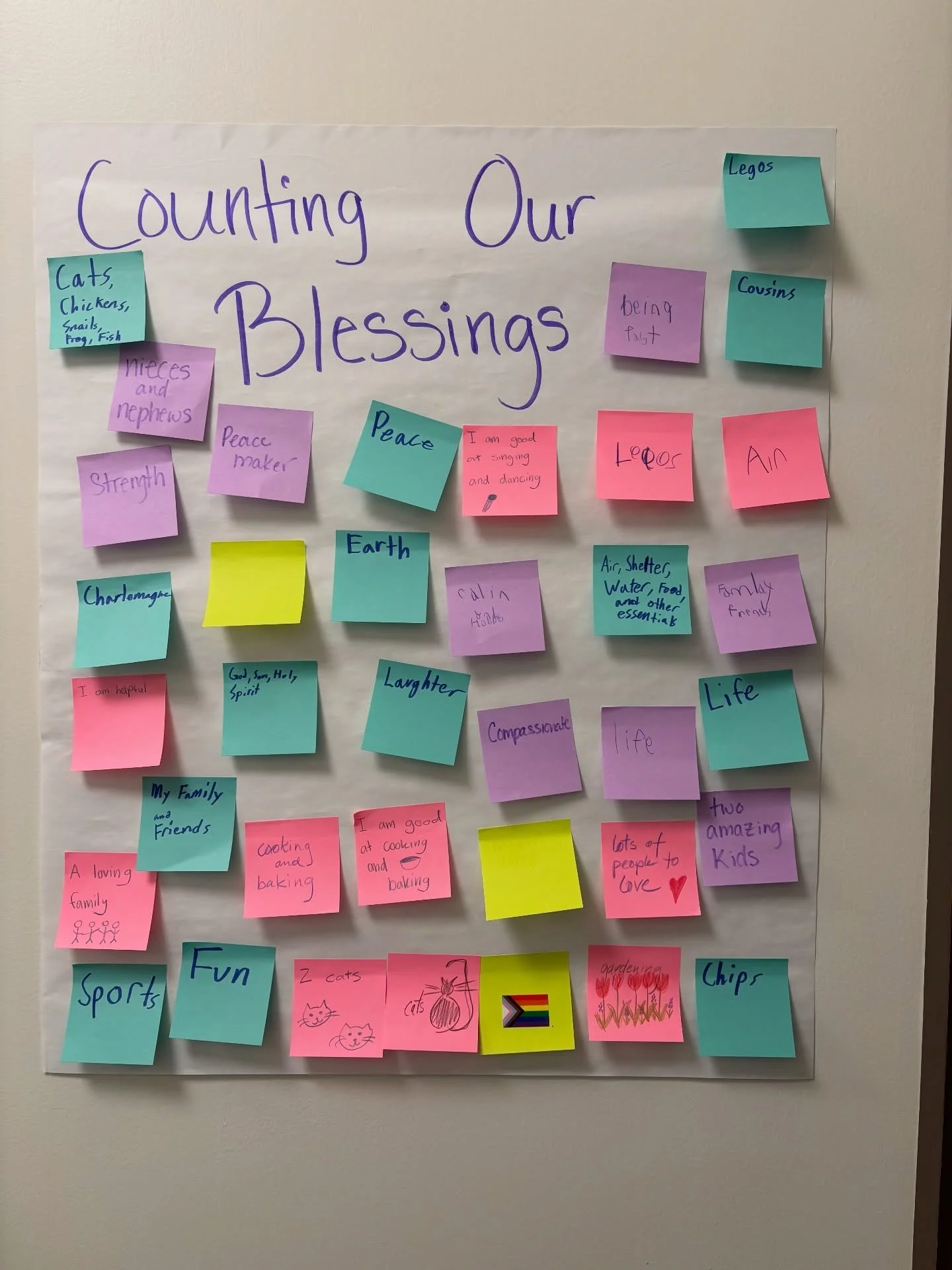
So what does all this have to do with life in Eugene? We’re not all going to move to Mexico and the program in Cuernavaca can only handle sixteen people at a time. No, the point is that the gifts of the spirit that Paul wrote about over two thousand years ago are still relevant and are being lived out in the world today. Being able to do that as much as anything comes down to the last thing Paul mentions in today’s reading: cheerfulness. Every day when we wake up we get to choose whether to start the day angry or happy. Heaven knows there are an infinite number of things to be angry about in today’s world: politics, the economy, the lack of firefighters in the forests, the difficulty getting medical care… as I said the list is infinite. We can choose to start the day focusing on our peeve of the day. Or we can wake up grateful. Grateful for another day to live on this earth, grateful for the wellbeing of the people we love, for the extraordinary beauty of the part of the world in which we live, for the opportunity to be part of a community as loving as this church family. This list is infinite also. If our perspective is one of gratitude then we’re going to wake up happy, and heaven knows the world needs more joy. Joy is contagious. Once a community becomes one whose persona is joyful then when tragedy strikes, when someone is diagnosed with a life threatening illness, others will be there, ready to do and be whatever the situation demands.
The last day in Cuernavaca we always have a fiesta. They set up tables outside, the food is always delicious, and part way through the meal the mariachis show up. It is so much fun. This year after the band had been playing for an hour or so they asked for requests and my Mexican friends called out a song. As soon as the music started something in me said it was time to dance. As soon as I stood up my friend Ave, the diocesan chancellor, and the bishop and his wife stood up as well. Soon, one by one my fellow students began joining us, and we danced. We danced because we were just too full of joy not to. We danced knowing that we would head to the airport in the morning and many of us would never see each other again, but in that moment we could rejoice in being together. We danced til the music stopped. I hope you can find reasons to dance too. Amen.